Introduction: The Corporate Reckoning
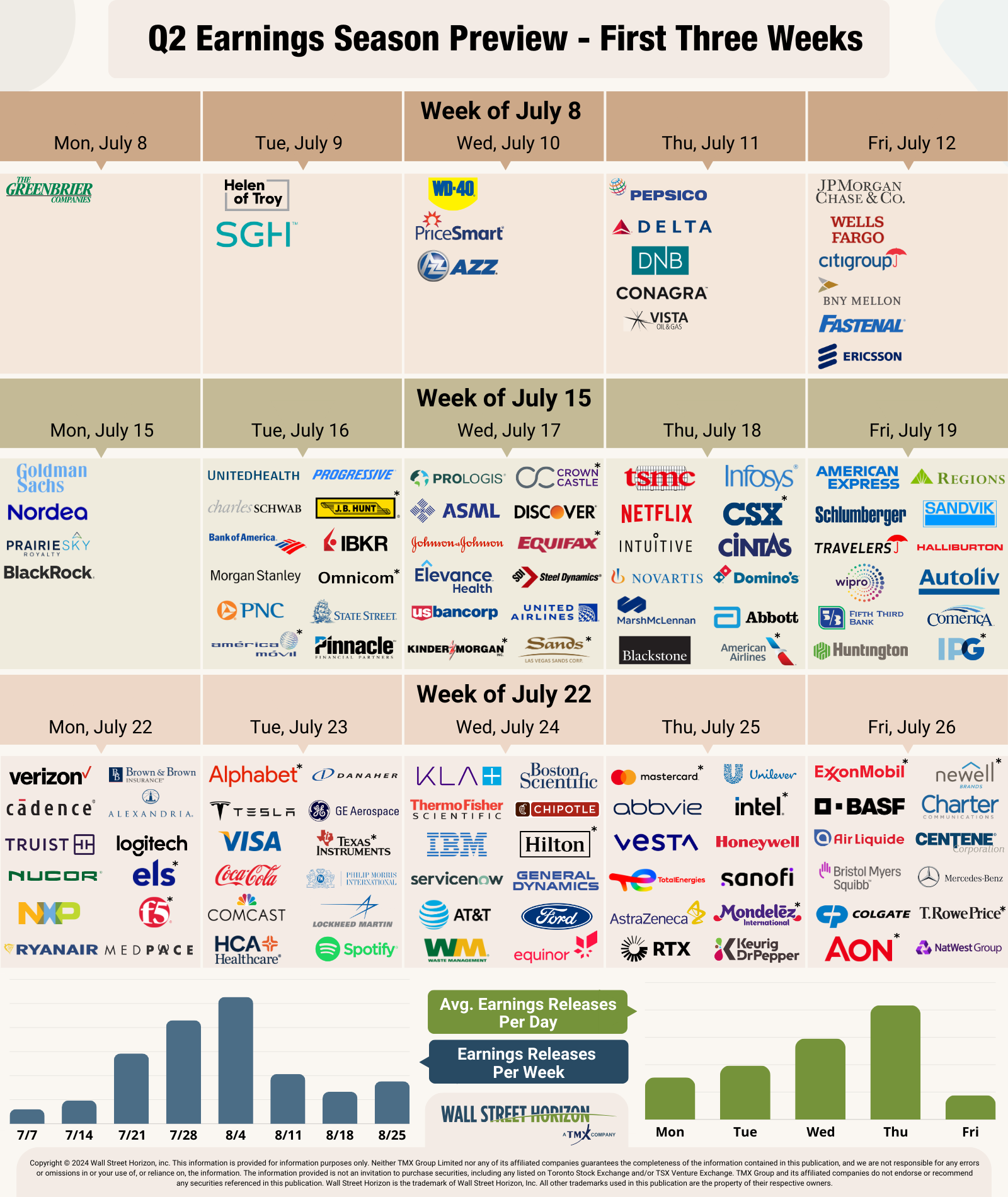
Earnings season is the stock market’s quarterly reckoning—a time when corporate narratives collide with financial reality. It’s when the grand themes of the economy—inflation, consumer resilience, the AI boom, interest rates—are distilled into the cold, hard numbers of revenue, profit, and guidance. For investors, this period is more than just a report card; it is a forward-looking diagnostic tool, offering critical insights into the health of the market and the broader U.S. economy.
The upcoming earnings season arrives at a moment of exceptional tension and uncertainty. The market is caught between the euphoria of the artificial intelligence revolution and the nagging fears of persistent inflation, “higher-for-longer” interest rates, and the potential for an economic slowdown. Are we on the cusp of a new, productivity-driven bull market, or is this a final rally before a fundamental downturn?
This article previews the upcoming earnings season by focusing on five bellwether U.S. companies. These are not merely random picks; they are strategically selected proxies for the most critical questions facing the market. By analyzing what to watch in their reports, we can decode the signals they send about the state of the American consumer, the health of corporate spending, the sustainability of the AI boom, and the resilience of the industrial core. This is not about predicting beats or misses, but about understanding the story the numbers tell and what it means for the market’s next move.
Section 1: The Macro Backdrop – The Stage is Set
Before diving into individual companies, it’s essential to set the stage by understanding the dominant macroeconomic forces that will define this earnings season.
1. The “Higher-for-Longer” Interest Rate Environment: The Federal Reserve has signaled that policy rates will likely remain elevated for an extended period. This has two primary effects on corporate America:
- Pressure on Financing Costs: Companies reliant on debt will see interest expenses rise, squeezing profitability.
- Valuation Compression: Higher discount rates continue to pressure the valuations of long-duration, growth-oriented stocks.
2. The Resilient, but Potentially Fraying, U.S. Consumer: Consumer spending accounts for nearly 70% of U.S. GDP. So far, it has remained surprisingly robust, supported by a strong labor market. However, cracks are appearing: rising credit card delinquencies, the resumption of student loan payments, and depleted pandemic-era savings are creating significant headwinds. This earnings season will be a crucial test of consumer endurance.
3. The AI Investment Boom – Hype vs. Reality: Corporate America is in the midst of a massive capital expenditure cycle focused on Artificial Intelligence. The key question is transitioning from “Who can build the AI infrastructure?” to “Who can monetize it?” Investors will be scrutinizing any mention of AI for tangible proof of revenue generation and profit accretion.
4. Margin Pressure and Pricing Power: While input cost inflation has cooled, wage inflation remains sticky. The ability of companies to maintain profit margins will depend on their pricing power. Those with strong brands and unique products can pass costs along; those without will see earnings contract.
With this backdrop in mind, let’s turn our attention to the five companies that will serve as our canaries in the coal mine.
Company 1: Amazon (AMZN) – The Barometer of Consumer and Cloud Spending
Ticker: AMZN
Sector: Consumer Discretionary & Technology
Why It’s a Bellwether: Amazon provides a unparalleled, dual-lens view of the economy. Its massive e-commerce platform offers a real-time pulse on the health of the U.S. consumer, while its Amazon Web Services (AWS) cloud division is the world’s leading indicator for corporate IT and technology spending.
What to Watch in the Report:
1. Amazon Web Services (AWS) Revenue Growth and Acceleration:
- The Metric: Year-over-year revenue growth for the AWS segment.
- What It Signals: After a period of significant slowdown as customers optimized their cloud spending, the key question is whether growth is re-accelerating. A sustained re-acceleration would signal that the corporate cost-cutting cycle is over and that enterprises are ramping up investments, particularly in new AI-driven workloads. Any commentary on the contribution of new AI services (like Bedrock and Trainium) to growth will be critical. Strong AWS growth is a bullish signal for the entire tech sector and corporate health.
2. North America & International Segment Operating Income:
- The Metric: Profitability of the core e-commerce business.
- What It Signals: This measures the efficiency of Amazon’s colossal retail operation. After a period of restructuring and cost-cutting, have they successfully driven sustained profitability in this low-margin business? Improving profits here, even on modest revenue growth, would demonstrate superb operational execution and show that the company can thrive even in a more cautious consumer environment. It signals resilience and managerial excellence.
3. Advertising Services Revenue Growth:
- The Metric: YoY growth of the high-margin advertising business.
- What It Signals: This is a pure play on brand and seller marketing budgets. Strong, resilient growth in ad revenue indicates that businesses are still confident in driving demand and that Amazon’s platform remains a essential marketing channel. A slowdown would suggest that smaller businesses and major brands are pulling back on discretionary ad spend, a potential early warning sign of consumer weakness.
The Bottom Line: A strong Amazon report, characterized by re-accelerating AWS growth and robust retail profits, would be a powerful all-clear signal for both the consumer and corporate America. A weak report, with slowing cloud growth and margin compression in retail, would raise significant red flags.
Company 2: JPMorgan Chase (JPM) – The Pulse of the Consumer and Corporate America
Ticker: JPM
Sector: Financials
Why It’s a Bellwether: As the nation’s largest bank, JPMorgan is a microcosm of the entire U.S. economy. Its results provide deep insight into the financial health of consumers (via credit card and mortgage data) and businesses (via commercial lending and investment banking activity).
What to Watch in the Report:
1. Net Interest Income (NII) Guidance:
- The Metric: Management’s forecast for future NII.
- What It Signals: NII is the profit engine of a bank—the difference between what it earns on loans and pays on deposits. The “higher-for-longer” rate environment has been a major tailwind, but that dynamic is shifting. As banks are now forced to pay more competitively for deposits (rising deposit betas), NII is plateauing or set to decline. If JPMorgan guides for a steeper-than-expected drop in NII, it signals that the peak profitability for the banking sector is in the rearview mirror, a negative for financial stocks.
Read more: Value vs. Growth: A Data-Driven Analysis of Which Strategy is Poised to Lead in the U.S. Market
2. Provision for Credit Losses:
- The Metric: The amount of money set aside to cover bad loans.
- What It Signals: This is the bank’s direct assessment of future economic risk. A steadily increasing provision indicates that JPMorgan’s sophisticated models are forecasting a rise in consumer and business defaults. Watch specifically for commentary on credit card and commercial real estate (CRE) delinquencies. A significant “jump” in provisions would be interpreted as the bank bracing for a economic downturn, sending a chilling signal across the market.
3. Investment Banking Revenue:
- The Metric: YoY growth in fees from M&A advisory and capital markets underwriting.
- What It Signals: Investment banking is a cyclical business that thrives on confidence. A sustained recovery in IB revenue would indicate that CEOs are confident enough to pursue mergers and acquisitions, and that companies are returning to the public markets. This is a key indicator of animal spirits and corporate confidence. Continued weakness suggests ongoing caution and a frozen deal-making environment.
The Bottom Line: JPMorgan is the market’s chief risk officer. Stable NII guidance, manageable credit provisions, and a rebounding investment banking business would suggest a “soft landing” is achievable. The opposite would fuel fears of a looming credit crunch and recession.
Company 3: NVIDIA (NVDA) – The Arbiter of the AI Hype Cycle
Ticker: NVDA
Sector: Information Technology
Why It’s a Bellwether: NVIDIA has become the poster child of the AI revolution. Its graphics processing units (GPUs) are the foundational “picks and shovels” for training and running large AI models. Its earnings are the purest read-through on the velocity of AI infrastructure spending.
What to Watch in the Report:
1. Data Center Revenue Growth and Guidance:
- The Metric: Quarterly revenue and forward guidance for the Data Center segment.
- What It Signals: This is ground zero for the AI boom. The key question is whether the astronomical growth rates of the past year are sustainable. The market has priced in near-perfect execution and continued hyper-growth. Any sign of a “digestion” period, where major cloud customers (like Azure, AWS, Google Cloud) pause to integrate the thousands of chips they’ve already purchased, would be a massive shock. Guidance is even more important than the past quarter’s results. It signals the durability of the AI capital expenditure wave.
2. Commentary on “Supply” vs. “Demand” Dynamics:
- The Metric: Management’s discussion on the balance between chip supply and customer demand.
- What It Signals: For quarters, the narrative has been that demand for H100 and next-generation B200 chips is “insatiable” and supply-constrained. The moment the conversation shifts to supply meeting or exceeding demand, it would indicate the peak growth phase is over. The market is watching for any cracks in the demand picture from large hyperscalers or specialized AI startups.
3. Gross Margins:
- The Metric: The company’s gross profit margin.
- What It Signals: NVIDIA has been achieving mind-boggling gross margins north of 75%. This is a testament to its monopolistic pricing power in high-performance AI chips. Any contraction in margins would be read as a sign of rising competition (from AMD, or custom silicon from cloud providers) or the need for discounting to clear inventory. Stable or expanding margins reinforce its unassailable competitive moat.
The Bottom Line: NVIDIA’s report is a binary event for the tech sector. A beat-and-raise report will be taken as confirmation that the AI revolution is still in its early innings, lifting the entire ecosystem. A miss or cautious guidance could trigger a severe correction, not just for NVDA, but for all AI-related stocks, as it would call the entire growth narrative into question.
Company 4: Starbucks (SBUX) – The Thermometer of the Discretionary Consumer
Ticker: SBUX
Sector: Consumer Discretionary
Why It’s a Bellwether: Starbucks sits at the perfect intersection of consumer behavior. A daily latte is a small, affordable luxury for many, but it is also one of the most easily cut items from a strained household budget. Its performance is a sensitive gauge of discretionary spending and trade-down behavior.
What to Watch in the Report:
1. Comparable Store Sales (“Comps”) in North America:
- The Metric: Year-over-year growth in sales at stores open at least one year.
- What It Signals: This is the most direct measure of consumer health. Positive comps driven by increased customer traffic are a very bullish sign, indicating that consumers are still willing to spend on small luxuries. Conversely, if comps turn negative or are only sustained through price increases (with falling traffic), it is a clear warning that consumers are pulling back. This is a real-time check on the “resilient consumer” narrative.
2. Average Ticket Size vs. Transaction Count:
- The Metric: The breakdown of comp growth between how much each customer spends (ticket) and how many customers come in (transactions).
- What It Signals: If growth is solely coming from a higher average ticket (price increases), it masks underlying weakness in customer visits. A decline in transaction count is a major red flag, showing that the consumer is actively cutting back, not just responding to inflation.
3. Commentary on the “Value-Seeking” Consumer:
- The Metric: Management’s qualitative remarks on consumer behavior.
- What It Signals: Listen for keywords like “trade-down,” “increased sensitivity,” or “focus on value.” If executives note that customers are shifting to cheaper customized drinks, using more rewards points, or visiting less frequently, it signals that the era of unflinching consumer strength is over. This would have negative read-throughs for all non-essential consumer discretionary companies.
The Bottom Line: Starbucks tells us what the consumer is feeling in their wallet. Strong traffic and comps suggest the consumer is still healthy. Weakness, especially in transactions, would be a powerful signal that the long-predicted consumer slowdown has finally arrived.
Company 5: Caterpillar (CAT) – The Gauge of Global Industrial Demand
Ticker: CAT
Sector: Industrials
Why It’s a Bellwether: Caterpillar’s iconic yellow machinery is used in construction, mining, and energy projects across the globe. Its orders and dealer inventories provide an unfiltered view of global industrial activity, commodity cycles, and the health of the infrastructure boom.
What to Watch in the Report:
1. Dealer Inventory Changes:
- The Metric: Whether dealers are adding to or reducing their inventory of CAT equipment.
- What It Signals: This is a crucial leading indicator. If dealers are aggressively building inventory, it signals strong end-demand expectations from construction and mining companies. Conversely, if dealers are drawing down inventory, it suggests that orders from the field are slowing, and a downturn in industrial activity may be imminent. A sustained inventory drawdown is a classic recessionary signal.
2. Sales Revenue by Segment (Construction, Resources, Energy):
- The Metric: YoY growth in the three primary segments.
- What It Signals:
- Construction Industries: Strength here is tied to non-residential construction and infrastructure spending from government bills like the IRA and CHIPS Act. Weakness could signal project delays or cancellations.
- Resource Industries: This is a direct play on global mining activity. Strong sales indicate that miners are investing in capacity to meet demand for metals used in the energy transition (copper, lithium).
- Energy & Transportation: Tied to oil & gas investment and marine shipping.
3. Pricing Power vs. Input Costs:
- The Metric: Operating margins.
- What It Signals: Caterpillar has demonstrated impressive pricing power. The key is whether it can continue to raise prices faster than its own rising costs for raw materials and labor. Stable or expanding margins show its brand and product strength allow it to navigate an inflationary environment, a sign of a high-quality industrial. Contracting margins would signal competitive pressures or an inability to fully pass on costs.
The Bottom Line: Caterpillar is a truth-teller on the global economic cycle. Strong, broad-based sales growth and healthy dealer inventories point to sustained global industrial strength. Weakness, especially in dealer inventories, is one of the most reliable early warnings of a looming industrial recession.
Read more: Beyond the Magnificent Seven: Identifying the Next Wave of High-Growth U.S. Tech Stocks
Conclusion: Weaving the Threads into a Coherent Narrative
Earnings season is a puzzle, and these five companies represent the most critical pieces. The story of the market’s next move will be written by the collective message from their reports.
- A “Goldilocks” or “Soft Landing” scenario would be characterized by: Amazon showing re-accelerating AWS growth and efficient retail ops; JPMorgan reporting stable NII and only a modest rise in credit provisions; NVIDIA delivering on its sky-high growth expectations; Starbucks maintaining positive traffic comps; and Caterpillar reporting healthy dealer inventory builds. This combination suggests a resilient consumer, a rebounding corporate profit cycle, and a sustainable AI boom.
- A “Hard Landing” or Recessionary scenario would be signaled by: Amazon reporting slowing cloud growth and weak retail margins; JPMorgan significantly boosting credit loss provisions; NVIDIA guiding for a growth slowdown; Starbucks reporting negative transaction growth; and Caterpillar showing a sharp drawdown in dealer inventories. This would indicate that higher rates are breaking the consumer, corporate spending is freezing, and the global economy is contracting.
- A “Stagflation-Lite” scenario might see Amazon and NVIDIA remain strong (tech resilience) while JPMorgan, Starbucks, and Caterpillar all show weakness. This would point to a K-shaped economy where tech and AI thrive, but the mainstream consumer and industrial base struggle under the weight of inflation and high rates.
For the investor, this preview provides a disciplined watchlist and a framework for interpretation. By focusing on the specific metrics outlined for these bellwethers, you can cut through the quarterly noise and understand the fundamental currents shaping the market. In a world of conflicting data and narratives, earnings season provides the hard evidence. It is our job to listen closely to what the evidence is saying.
Frequently Asked Questions (FAQ)
Q1: When is the main “earnings season”?
A: While companies report quarterly, the densest concentration of reports, known as “earnings season,” occurs in the several weeks following the end of each fiscal quarter. The key periods are:
- Mid-January to Mid-February for Q4 (full-year) results.
- Mid-April to Mid-May for Q1 results.
- Mid-July to Mid-August for Q2 results.
- Mid-October to Mid-November for Q3 results.
The reports from major banks like JPMorgan traditionally mark the unofficial start of each season.
Q2: What’s more important, the earnings result for the past quarter or the guidance for the next quarter?
A: Guidance is almost always more important. The stock market is a forward-looking mechanism. A company can beat earnings for the past quarter but see its stock price fall precipitously if it provides weak or disappointing guidance for the future. Conversely, a company might miss on the past quarter but see its stock rise if it provides strong, confident guidance that suggests the miss was a temporary blip.
Q3: What is an “earnings call” and where can I listen to it?
A: An earnings call is a conference call hosted by a company’s management (typically the CEO and CFO) after releasing their earnings report. They walk investors and analysts through the results and then take questions. The initial presentation often contains the most crucial information on guidance and strategy. You can find links to live webcasts and replays in the “Investor Relations” section of a company’s website.
Q4: I’ve heard the terms “whisper number” and “beat and raise.” What do they mean?
- Whisper Number: An unofficial, unpublished earnings per share (EPS) or revenue forecast that circulates among professional traders. It is often higher than the official Wall Street consensus estimate. If a company beats the consensus but misses the whisper number, the stock can sometimes still fall.
- Beat and Raise: This is the ideal outcome. It means a company both beat the consensus estimates for the past quarter and raised its own guidance for future quarters. This often leads to a significant rally in the stock price as it signals accelerating business momentum.
Q5: As a long-term investor, how much should I worry about a single quarter’s earnings?
A: For a long-term investor, a single quarter should not drastically alter your thesis unless it reveals a fundamental, permanent breakdown in the business model (e.g., a key product is failing, a major competitor is taking irreversible market share). Volatility around earnings is normal. Focus on the long-term trends: is the company gaining market share? Are its competitive moats intact? Is management executing its strategy? Use quarterly reports as checkpoints to confirm or challenge your long-term thesis, not as triggers for impulsive trading.
Q6: Besides these five, what other sectors should I watch for a complete picture?
A: These five provide a broad view, but a complete picture includes:
- Healthcare (e.g., UnitedHealth – UNH): For insights into the massive U.S. healthcare system and consumer health spending.
- Semiconductors (e.g., AMD, TSM): To corroborate the NVIDIA story and gauge broader tech demand beyond AI.
- Transportation (e.g., FedEx – FDX, Union Pacific – UNP): For a real-time look at the movement of goods across the economy, a classic leading indicator.
- Housing (e.g., Lennar – LEN, Home Depot – HD): To gauge the health of the housing market, which is highly sensitive to interest rates.
Disclaimer: This article is for informational and educational purposes only and should not be construed as specific investment, financial, or trading advice. The companies mentioned are for illustrative purposes only and are not recommendations. The analysis presented is based on current market conditions and expectations, which are subject to change rapidly. All investing involves risk, including the possible loss of principal. Investors should conduct their own due diligence and consult with a qualified financial advisor before making any investment decisions.
Read more: Technical Breakdown: Is the S&P 500 Showing Signs of a Bullish Reversal or a Bear Trap?