
In the vast, often turbulent ocean of the financial markets, having a reliable navigational tool is not just an advantage—it’s a necessity. For countless traders and investors, that tool is technical analysis. By studying historical price action and volume data, technical analysis helps us decipher the market’s psychology, identify potential trends, and, crucially, pinpoint key levels where the balance between supply and demand may shift.
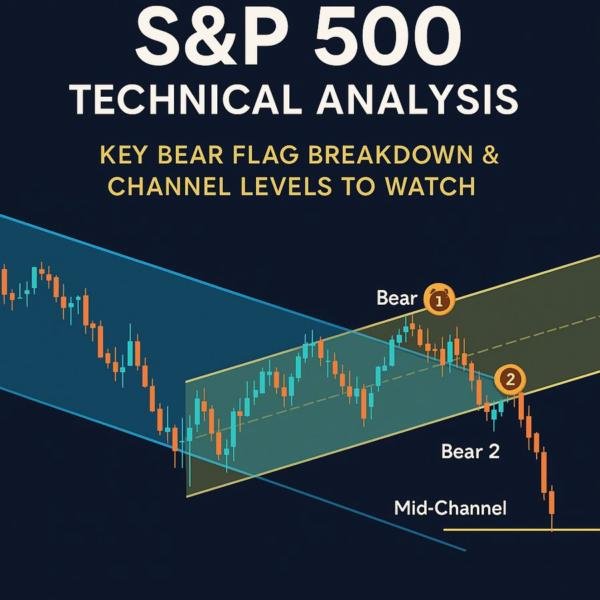
This article provides a deep, technical dissection of the current market landscape. We will first embark on a macro-level journey, analyzing the benchmark S&P 500 index. Understanding the broader market’s health and its critical support and resistance levels is paramount, as it sets the tide that lifts or sinks most individual boats. We will identify the precise price zones that institutional and retail traders are watching closely, levels that could dictate the market’s next major move.
Following this macro overview, we will zoom into the micro-level, isolating three individual stocks that are exhibiting compelling technical formations suggestive of an impending breakout. These are not mere hunches; they are setups grounded in classical chart patterns, robust volume analysis, and key momentum indicators. We will dissect each chart, define its crucial trigger points, and outline the tactical implications for both bullish and bearish scenarios.
Our goal is to equip you with a framework for informed decision-making, blending the science of chart patterns with the art of risk management. Let’s begin with the market’s most critical barometer: the S&P 500.
Part 1: The Macro Picture – Decoding the S&P 500’s Critical Juncture
The S&P 500 is more than an index; it is a reflection of the collective heartbeat of the U.S. economy’s largest and most influential companies. Its chart tells a story of prevailing trends, investor sentiment, and underlying economic strength or fragility. Our analysis will focus on a multi-timeframe perspective, using a weekly chart to identify the primary trend and key macro levels, supplemented by a daily chart for more immediate tactical insights.
The Long-Term Trend: A Bullish Foundation with Cracks to Monitor
On a multi-year weekly chart, the primary trend for the S&P 500 remains unequivocally bullish. The index has been trading in a well-defined upward channel since the lows of 2009, with the sharp COVID-induced crash in 2020 serving as a dramatic, but ultimately contained, violation. The powerful rally from the October 2023 lows reaffirmed this long-term bullish structure.
However, since late 2021, the index has entered a phase of heightened volatility and consolidation. It is within this larger context that we must identify our immediate, actionable key levels.
Key Resistance: The Ceiling the Bulls Must Break
- The All-Time High (ATH) Zone (~5,200 – 5,300): The most significant resistance level is always the prior all-time high. For the S&P 500, this zone represents a psychological and technical barrier. A decisive weekly close above this level (we’ll define “decisive” shortly) would signal a resumption of the long-term bull market, potentially opening the door for a new leg higher. Until this level is conquered, the possibility of a double-top or extended consolidation remains.
- The Upper Boundary of the Consolidation Range: If we draw the highs from 2022 and 2024, we see a clear upper boundary to the recent multi-year consolidation. A break above this line, especially on high volume, would be a powerful confirmation of a new bullish phase.
Key Support: The Floor the Bears Must Shatter
- The 50-Day and 200-Day Simple Moving Averages (SMAs): These are dynamic support levels watched by nearly every trend-following market participant.
- The 50-Day SMA represents the short-to-medium-term trend. A breach can signal waning momentum.
- The 200-Day SMA is the granddaddy of trend indicators, representing the long-term health of the market. A sustained break below this level, particularly on a weekly closing basis, is often considered a warning sign of a potential trend reversal from bull to bear. As of this writing, the index trading above both its 50-day and 200-day SMAs is a positive sign for the bulls.
- The 5,000 Psychological Level: Round numbers act as powerful psychological magnets. The 5,000 level is a major support zone. A break below it would likely trigger a wave of selling from both algorithmic systems and nervous investors.
- The Primary Upward Trend Line (From October 2023 Lows): This is the most critical support level for the current bull run. This ascending line connects the significant lows from October 2023, January 2024, and April 2024. A decisive break below this trendline would indicate that the intermediate-term uptrend has been broken, likely leading to a test of deeper support levels, potentially down to the 4,800 – 4,600 zone.
What Constitutes a “Decisive” Break?
This is a critical concept in technical analysis. A mere intraday poke above resistance or below support is often a false signal (a “fakeout”). A decisive break is typically confirmed by:
- A Weekly Close: The price closes the trading week beyond the level.
- Accompanying Volume: The breakout/breakdown occurs on higher-than-average volume, indicating conviction.
- Follow-Through: Subsequent price action confirms the move, instead of immediately reversing.
S&P 500 Outlook: The index is at a critical juncture, compressed between its primary rising support trendline and the formidable resistance of the all-time highs. The next major move will likely be determined by which of these key levels gives way first. For now, the benefit of the doubt goes to the bulls as long as the index holds above its 50-day SMA and the primary trendline.
Part 2: The Micro Opportunities – 3 Stocks Setting Up for a Breakout
With the macro backdrop established, we can now focus on individual stocks that are showing strength and technical promise, even within a range-bound broader market. The following three stocks have been selected based on their clear chart patterns, constructive volume profiles, and proximity to key breakout levels.
A Critical Pre-Analysis Note on Risk Management:
Before entering any trade based on a breakout thesis, always define your risk. The most effective method is to identify the pattern’s “failure level”—the point at which the bullish or bearish thesis is invalidated. Your stop-loss order should be placed just below (for long trades) or above (for short trades) this level. Proper position sizing is essential to ensure that a single losing trade does not significantly damage your portfolio.
Stock #1: Snowflake Inc. (SNOW) – The Coiled Spring
Snowflake, a cloud-based data-warehousing company, has been a poster child for the growth-stock boom and subsequent correction. After a brutal bear market throughout 2022 and much of 2023, its chart is now exhibiting signs of a major basing pattern, suggesting the potential for a significant trend change.
Technical Pattern: Multi-Month Inverse Head and Shoulders (H&S) Bottom
The Inverse Head and Shoulders is one of the most reliable trend-reversal patterns in technical analysis. On SNOW’s weekly chart, we can identify its components:
- Left Shoulder (LS): The sell-off low around $142 in May 2023.
- Head (H): The deep, capitulatory low near $125 in October 2023.
- Right Shoulder (RS): A higher low formed around $155 in April 2024.
- Neckline: The key resistance level connecting the peaks between the Left Shoulder and Head, and the Head and Right Shoulder. For SNOW, this neckline currently sits in the $185 – $190 zone.
Why This Setup is Compelling:
- Symmetry: The pattern is remarkably symmetrical, with the right shoulder taking a similar amount of time to form as the left.
- Volume Diminishing: Volume has been noticeably lighter on the formation of the right shoulder compared to the left shoulder and head, a classic sign that selling pressure is exhausting.
- Momentum Bullish Divergence: During the formation of the head (the lowest price), the Relative Strength Index (RSI) made a higher low. This bullish divergence indicated that downward momentum was waning even as price made a new low.
The Key Breakout Level and Trigger:
The all-important trigger for a bullish entry is a decisive break above the $190 neckline resistance, preferably on a weekly closing basis and accompanied by a surge in volume.
Projection and Risk Management:
- Measured Move Target: The classic Inverse H&S projection is derived by measuring the distance from the head’s low to the neckline and projecting that upward from the breakout point. With a head at ~$125 and a neckline at ~$185, the pattern height is $60. A breakout above $190 would project a initial price target of $190 + $60 = $250.
- Stop-Loss Level: The bullish thesis would be invalidated if the stock price were to reverse and fall back below the right shoulder’s low, around $155. A prudent stop-loss would be placed just below this level.
Summary for SNOW: The stock is a coiled spring, representing a high-reward, high-risk bet on a major trend reversal. The trade is only activated on a confirmed breakout above $190, with a clear invalidation point below $155.
Stock #2: Caterpillar Inc. (CAT) – The Cyclical Powerhouse Poised for a Run
Caterpillar is a bellwether for global industrial and construction activity. Its chart reflects the health of the global economy, and it is currently forming a powerful continuation pattern after a strong multi-year uptrend.
Technical Pattern: Bull Flag on the Weekly Chart
A bull flag is a pause pattern that forms after a sharp, strong upward move (the “flagpole”). It represents a period of consolidation where the market digests its recent gains before the next leg higher. The pattern is characterized by parallel or slightly downward-sloping consolidation channels.
On CAT’s chart, we observe:
- The Flagpole: The powerful rally from roughly $210 in September 2023 to a high near $380 in March 2024.
- The Flag: The subsequent multi-week consolidation between approximately $330 and $380. This consolidation is happening on declining volume, which is exactly what we want to see in a healthy bull flag.
Why This Setup is Compelling:
- Strong Underlying Trend: The pattern is occurring within a well-established, powerful primary uptrend.
- Shallow Pullback: The consolidation within the flag has retraced only a small portion of the flagpole’s gains, indicating that sellers are lacking conviction.
- Respect of Key Moving Averages: The 50-day SMA has acted as dynamic support during the flag’s formation, a sign of ongoing institutional support.
The Key Breakout Level and Trigger:
The trigger for a new bullish wave is a decisive break above the flag’s upper resistance boundary, which coincides with the all-time high near $380. A weekly close above this level, especially on a volume spike, would be the confirmation signal.
Projection and Risk Management:
- Measured Move Target: The classic bull flag projection is derived by measuring the length of the flagpole and projecting it upward from the breakout point. The flagpole from ~$210 to ~$380 is a $170 move. A breakout above $380 projects a initial price target of $380 + $170 = $550.
- Stop-Loss Level: The bull flag pattern would be invalidated by a break below the flag’s lower support trendline, around $330. A stop-loss can be placed just below this level to protect capital in case the pattern fails.
Summary for CAT: This is a classic “trend is your friend” setup. CAT offers a lower-risk entry point to participate in a strong existing uptrend. The setup suggests the stock is merely catching its breath before its next powerful move higher.
Read more: Beyond the Magnificent Seven: Identifying the Next Wave of US Tech Growth Stocks
Stock #3: Palantir Technologies Inc. (PLTR) – The AI Play Breaking Out of a Base
Palantir, a specialist in big data analytics, has been one of the darlings of the AI revolution. Its stock experienced a massive run in late 2023 and early 2024 and has since been building a new foundation for its next potential advance.
Technical Pattern: Ascending Triangle on the Daily Chart
An ascending triangle is a bullish continuation pattern characterized by a flat resistance line and a rising support line (forming higher lows). It indicates that buyers are becoming increasingly aggressive with each pullback, while sellers are persistent at a specific price level. The pattern is typically resolved with a breakout to the upside.
On PLTR’s daily chart, we can see:
- Horizontal Resistance: A clear resistance level has been established around $27.50. The stock has tested this level multiple times.
- Ascending Support (Higher Lows): Each pullback from the $27.50 resistance has found support at a progressively higher level—$20.50, then $22.50, then $23.50. This creates a rising trendline.
Why This Setup is Compelling:
- Accumulation Behavior: The pattern of higher lows suggests steady accumulation. Buyers are willing to step in at higher and higher prices, unwilling to wait for a deeper pullback.
- Coiling Effect: The converging trendlines create a “coiling” effect, building energy for a potential explosive move.
- Context: The pattern is forming after a significant prior uptrend, aligning with the continuation pattern definition.
The Key Breakout Level and Trigger:
The trigger is straightforward: a decisive break and daily close above the $27.50 resistance level. This breakout should be validated by a significant increase in trading volume, confirming that the buying pressure has finally overwhelmed the sellers at that key price.
Projection and Risk Management:
- Measured Move Target: The minimum projected move for an ascending triangle is the height of the pattern’s widest point, added to the breakout level. The pattern’s initial height is roughly $7 ($27.50 – $20.50). A breakout above $27.50 projects a initial price target of $27.50 + $7 = $34.50.
- Stop-Loss Level: The bullish thesis for the pattern is invalidated if the price breaks down below the ascending support trendline. Given the most recent higher low is around $23.50, a logical stop-loss would be placed just below that level, perhaps near $22.75.
Summary for PLTR: PLTR is demonstrating classic signs of accumulation and is pressing against a key resistance wall. A breakout above $27.50 would signal the resumption of its powerful uptrend and could lead to a rapid move toward the mid-$30s.
Conclusion: Synthesizing the Macro and Micro
Successful trading and investing are not just about picking winning stocks; they are about understanding the environment in which those stocks live. Our analysis reveals a S&P 500 at a critical inflection point, wrestling with the gravitational pull of its all-time highs while being supported by a resilient primary trend. The direction of its next decisive move will heavily influence the success rate of individual stock breakouts.
The three stocks we’ve dissected—SNOW, CAT, and PLTR—each offer a unique technical narrative. SNOW presents a high-potential trend reversal play, CAT a steady and powerful continuation setup, and PLTR a dynamic, momentum-driven breakout from a coiled consolidation. Despite their differences, they share a common thread: they are all approaching well-defined, technically significant levels that will determine their next major directional move.
The key takeaway is patience and discipline. Do not anticipate the breakout. Wait for the market to show its hand through a decisive move above (or below) the identified key levels, supported by the volume and price action confirmation we’ve discussed. Always enter with a predefined plan that includes your profit target and, just as importantly, your stop-loss level to manage risk.
The charts are speaking. It is our job to listen, interpret, and act with precision when the signal is clear.
Read more: The Pillars of Value: A Deep Dive into 3 Undervalued US Blue-Chip Stocks
Frequently Asked Questions (FAQ)
Q1: I’m new to technical analysis. What are the 3 most important concepts I should master first?
A1: Start with these three foundational pillars:
- Support and Resistance: These are the price levels where buying (support) or selling (resistance) pressure has historically emerged. They are the bedrock of all technical analysis.
- Trend Identification: Learn to determine the market’s direction using tools like higher highs/higher lows (uptrend), lower highs/lower lows (downtrend), and moving averages. “The trend is your friend” is a famous adage for a reason.
- Volume Confirmation: Volume is the fuel behind price moves. A breakout or breakdown on high volume is far more credible than one on low volume. It indicates conviction from larger market participants.
Q2: What’s the difference between a “breakout” and a “fakeout”?
A2: A breakout is a decisive and sustained move beyond a key level of support or resistance, confirmed by factors like a strong closing price (e.g., daily or weekly close) and high volume. It signifies a genuine shift in the supply/demand balance.
A fakeout (or false breakout) is a brief, unconvincing move beyond a key level that quickly reverses. It often traps traders who entered prematurely and is typically characterized by low volume and a lack of follow-through. Waiting for confirmation is the best defense against fakeouts.
Q3: How do you use moving averages in your analysis?
A3: Moving averages (MAs) serve two primary purposes:
- Trend Identification: The position of the price relative to its key MAs (like the 50-day and 200-day) helps define the trend. Price above both is generally bullish; below both is generally bearish.
- Dynamic Support/Resistance: MAs often act as floating support in uptrends and resistance in downtrends. A bounce off the 50-day SMA in an uptrend, for example, is a positive sign.
Q4: The article mentions RSI. What is it and how is it used?
A4: The Relative Strength Index (RSI) is a momentum oscillator that measures the speed and change of price movements on a scale of 0 to 100.
- Overbought/Oversold: Traditionally, readings above 70 suggest an asset may be overbought (ripe for a pullback), while readings below 30 suggest it may be oversold (ripe for a bounce). However, in strong trends, RSI can remain in overbought or oversold territory for extended periods.
- Divergence: This is often a more powerful signal. A bullish divergence occurs when price makes a new low but RSI makes a higher low, indicating weakening downward momentum. The opposite is a bearish divergence.
Q5: Why is the S&P 500’s 200-day moving average so important?
A5: The 200-day moving average is widely regarded as the primary demarcation line between a long-term bull and bear market. A significant portion of institutional investors, fund managers, and algorithmic trading systems use this level to make major allocation decisions. A sustained break below it can trigger massive systematic selling, while holding above it reinforces bullish confidence.
Q6: Is technical analysis a self-fulfilling prophecy?
A6: To some extent, yes, and that is part of its power. Because so many market participants are watching the same key levels (like the S&P 500’s 200-day MA or a stock’s all-time high), their collective actions based on these levels can indeed influence price. If everyone sees $190 as resistance for SNOW and places sell orders there, it becomes resistance. If it breaks, and everyone sees it as a buy signal, it fuels the breakout.
Q7: Can technical analysis be used for long-term investing, or is it just for trading?
A7: Absolutely. While often associated with short-term trading, the principles of technical analysis are invaluable for long-term investors. It can help an investor:
- Identify optimal entry points for a long-term position (e.g., buying on a pullback to a key support level in a long-term uptrend).
- Avoid buying into assets that are in a clear, long-term downtrend.
- Make more informed decisions about when to trim or add to a position.
Q8: What is the single biggest mistake novice technical analysts make?
A8: The most common mistake is overcomplicating the chart. Novices often load their charts with dozens of indicators, lines, and oscillators, leading to “analysis paralysis” and contradictory signals. The cleanest charts are often the most effective. Price and volume are the most important data points. Start with simple support/resistance, trendlines, and perhaps one or two indicators like volume and RSI. Master the basics before adding complexity.