The world of penny stocks is one of the most alluring, yet misunderstood, arenas in the entire financial landscape. It’s a place where stories of turning a few thousand dollars into a small fortune spread like wildfire, capturing the imagination of aspiring investors seeking to carve their own path to financial freedom. The idea of finding the “next Amazon” or “next Apple” while it’s still trading for pennies is a powerful dream, deeply embedded in the American spirit of opportunity.
But for every legendary success story, there is a graveyard of lost capital. The same volatility that can create meteoric rises can also lead to catastrophic losses. The market for stocks under $5 is a wild frontier, less regulated, and fraught with pitfalls like manipulation, fraud, and extreme illiquidity.
This guide is not here to sell you a dream. It is here to provide a reality-based, educational playbook. Our mission is to equip you with the knowledge, strategies, and, most importantly, the risk management framework to navigate this high-stakes environment. We will prioritize your financial education and safety above all else, adhering to the principles of Experience, Expertise, Authoritativeness, and Trustworthiness (EEAT). Consider this your first and most crucial step before you ever place a trade.
Chapter 1: What Exactly Are Penny Stocks? (It’s More Than Just Price)
While the common definition of a penny stock is a share that trades for less than $5, the official U.S. regulatory definition provides a more nuanced picture. According to the U.S. Securities and Exchange Commission (SEC), a penny stock is generally defined as:
- A security issued by a small, public company that trades at less than $5 per share.
- Not listed on a national securities exchange (like the NYSE or NASDAQ). Instead, they trade “over-the-counter” (OTC) through quotation services like the OTC Markets Group.
- Companies with net tangible assets of less than $2 million (if they have been in business for over three years) or $5 million (if they have been in business for less than three years).
- Companies with average revenue of less than $6 million for the last three years.
Key Takeaway: The price is just one factor. The primary characteristic is that these are small, often speculative companies that do not meet the stringent listing requirements of major exchanges. This lack of oversight is the source of both their opportunity and their extreme risk.
Where Do Penny Stocks Trade? Understanding the OTC Market
Most classic penny stocks trade on the OTC markets. Think of this as the “off-Broadway” of the financial world. Instead of a centralized exchange floor, trading happens through a network of broker-dealers. The OTC Markets Group has created tiers to help investors gauge the risk and quality of information available:
- OTCQX® Best Market: The top tier. Companies must meet high financial standards, be current in their disclosure, and undergo a qualitative review. This is where you’ll find the highest quality OTC companies (e.g., many international giants that also list abroad).
- OTCQB® Venture Market: The “venture stage” market for early-stage and developing U.S. and international companies. Companies must be current in their reporting and undergo an annual verification and certification process. It’s a step up from the Pink market.
- Pink Open Market (Pink Sheets): This is the most speculative and risky tier. It has three categories:
- Current Information: Companies that provide updated disclosure.
- Limited Information: Typically small companies with financial distress.
- No Information: The highest risk. Companies that do not provide any disclosure to the public.
A critical point for beginners: Many brokers, especially those geared toward new investors, do not allow trading in Pink Sheet stocks, particularly the “No Information” tier, due to the extreme risks involved.
Chapter 2: The Unvarnished Truth: Risks and Rewards
Before you invest a single dollar, you must internalize the risks. This is the cornerstone of a trustworthy guide.
The Glaring Risks:
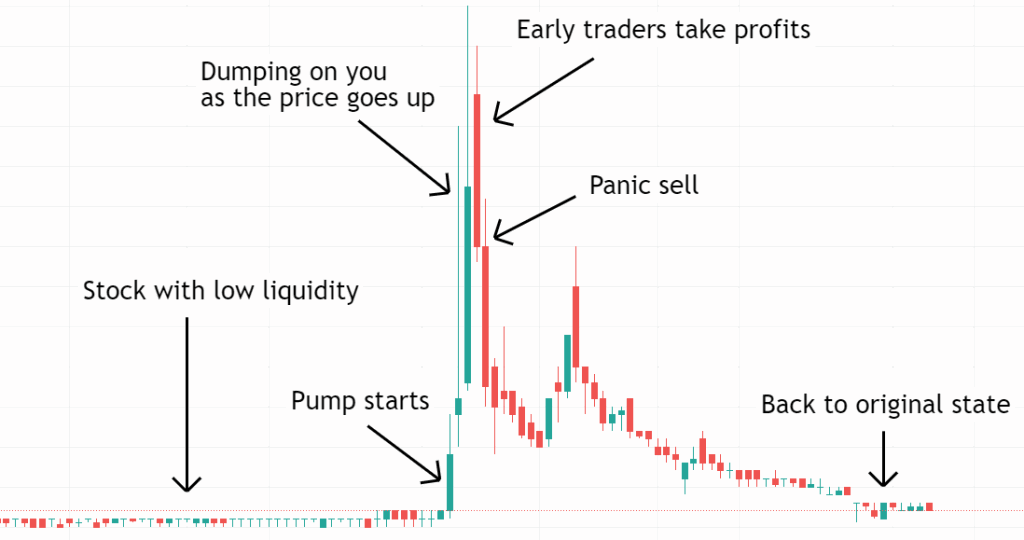
- Lack of Liquidity: Liquidity refers to how easily you can buy or sell an asset without affecting its price. Penny stocks are often illiquid. You might own a stock that is rising on paper, but if there are no buyers when you want to sell, you can be stuck, forced to watch your gains evaporate or sell at a much lower price.
- Limited Public Information & Disclosure: Unlike companies on the NYSE or NASDAQ, OTC companies are not always required to file detailed, audited financial reports with the SEC. This makes it incredibly difficult to perform fundamental analysis and truly understand the company’s health.
- High Volatility: Penny stocks can experience wild price swings of 50%, 100%, or more in a single day. This volatility can be driven by a small news release or even a coordinated pump-and-dump scheme, not the underlying business fundamentals.
- The “Pump and Dump”: This is a classic and rampant scam. Unscrupulous promoters buy a large amount of a very cheap stock. They then aggressively “pump” it through newsletters, social media, and message boards with false or exaggerated claims. As new, unsuspecting buyers rush in and drive the price up, the promoters “dump” their shares at a profit, leaving everyone else with worthless stock.
- Fraud and Manipulation: The low-regulation environment can attract companies with poor business models, overstated assets, or, in the worst cases, outright fraudulent operations.
- Brokerage Challenges: As mentioned, some brokers restrict OTC trading. Those that allow it often charge higher fees or commissions per trade, which can eat significantly into the profits of small-scale trades.
The Potential Rewards (The “Why”):
- High Growth Potential: You are investing in micro-cap companies. A small amount of success—a new contract, a successful drug trial, a innovative product—can lead to exponential percentage growth that a large, established company like Apple could never achieve.
- Low Barrier to Entry: With share prices often under $1, you can establish a position with a relatively small amount of capital.
- Discovery & Diversification: For sophisticated investors, allocating a very small portion of a portfolio to high-risk penny stocks can be a way to speculate on emerging industries or technologies.
The Professional Perspective: Seasoned traders understand that the “reward” in penny stocks is not a guarantee; it’s a potential outcome that must be rigorously pursued through research and fiercely protected through risk management. The goal is not to get rich quick, but to identify asymmetric risk/reward opportunities where the potential upside justifies the well-understood downside.
Chapter 3: The All-American Due Diligence Checklist
Never buy a penny stock based on a tip from a forum, a newsletter, or a social media post. Your number one job is to be a detective. Here is a step-by-step checklist to follow for every single stock you consider.
Step 1: Identify the Trading Venue
- Is it on OTCQX, OTCQB, or the Pink Sheets? Start with OTCQX and OTCQB companies. Be extremely wary of Pink Sheets, especially those with “Limited” or “No Information.”
Step 2: Scour the SEC’s EDGAR Database
- Go to www.sec.gov/edgar. Search for the company’s ticker symbol.
- What to look for: If the company files reports, read the annual report (Form 10-K) and quarterly reports (Form 10-Q). Pay attention to the balance sheet (assets vs. liabilities), the income statement (revenue and profit/loss), and the statement of cash flows (is the company burning cash?).
Step 3: Analyze the Company’s Financial Health
- Revenue & Growth: Is the company generating revenue? Is that revenue growing?
- Profitability: Is the company profitable? If not, how long can it survive with its current cash (its “runway”)?
- Debt: How much debt does the company have? High debt is a major red flag for a small company.
- Float & Outstanding Shares: How many shares are available to trade (the “float”)? A very small float can lead to extreme volatility. Also, check if the company has a history of diluting shareholders by issuing more shares.
Step 4: Understand the Business and Management
- The Business Model: In one simple sentence, what does this company do to make money? If you can’t understand it, avoid it.
- The Management Team: Look up the CEO and key executives. Do they have relevant experience? A history of success? Or a history of failed ventures?
Step 5: Read the News and Identify Catalysts
- What is happening with the company now? Is there a new product launch, an FDA approval pending, a major partnership? A “catalyst” is a near-term event that could legitimately change the company’s value.
Chapter 4: A Beginner’s Trading Strategy: The “Quality Scout” Approach
For a beginner, we recommend avoiding day-trading and hyper-speculative plays. Instead, adopt a “Quality Scout” mindset.
The Philosophy: Your goal is to find the highest-quality companies within the penny stock universe—those with real businesses, real revenue, solid management, and that trade on the OTCQX or OTCQB tiers. You are looking for emerging micro-caps, not lottery tickets.
The Process:
- Screen for Quality: Use free stock screeners (like Finviz, or the OTC Markets’ own screener) and apply these filters:
- Price: < $5.00
- Exchange: OTCQX or OTCQB
- Average Volume: > 100,000 (to ensure some liquidity)
- Revenue (if available): > $1 Million
- Create a Watchlist: Don’t buy immediately. Add 5-10 companies that pass your initial screen to a watchlist.
- Perform Deep Due Diligence: Use the checklist from Chapter 3 on every company on your watchlist.
- Determine Your Entry: After your research, decide on a price you’d be comfortable paying. Use a “limit order” (not a market order) to ensure you don’t overpay due to volatility.
- Plan Your Exit Before You Enter: This is non-negotiable.
- Profit-Taking Target: Decide at what percentage gain you will sell a portion or all of your position (e.g., 25%, 50%, 100%).
- Stop-Loss Order: Decide the maximum loss you are willing to take on the trade (e.g., 15-20%) and set a stop-loss order with your broker to automatically sell if the price hits that level. This is your single most important risk-management tool.
Chapter 5: Executing Your First Trade: A Practical Walkthrough
Let’s assume you’ve done your research on a fictional company, “BioHeal Inc.” (Ticker: BHLI), an OTCQB-listed biotech with a promising drug in Phase 2 trials, $5 million in cash, and low debt. The stock is currently trading at $1.50.
- Fund Your Account: Ensure you have settled cash in your brokerage account. (Remember, some brokers have a settlement period after you deposit funds).
- Position Sizing: You have a $2,000 speculative portfolio. Following the golden rule of never risking more than you can afford to lose, you decide to invest only $500 in BHLI. This is your position size.
- Place a Limit Order:
- You log into your brokerage platform.
- You enter the ticker symbol “BHLI”.
- You select “Buy.”
- You select “Order Type: Limit.”
- You enter “Shares: 333” ( $500 / $1.50 = ~333 shares).
- You set your “Limit Price: $1.52.” You’re willing to pay a little above the current price to ensure a fill, but not more.
- You select “Duration: Day” (meaning if it doesn’t fill that day, the order cancels).
- You click “Submit Order.”
- Immediately Set a Stop-Loss:
- Your stop-loss is set at 20% below your entry: $1.50 * 0.80 = $1.20.
- You place a “Sell Stop Limit Order” for 333 shares of BHLI with a stop price of $1.20 and a limit price of $1.18. This will automatically trigger a sell order if the price drops to $1.20, protecting you from a larger crash.
- Set a Sell Limit Order for Profit-Taking (Optional but Recommended):
- Your target is a 50% gain: $1.50 * 1.50 = $2.25.
- You can place a “Sell Limit Order” for 333 shares at $2.25. This will automatically sell your position if the price reaches your target.
Congratulations, you have just placed a disciplined, research-driven penny stock trade.
Read more: Degenerate or Genius? We Backtested Last Month’s Top 10 WSB YOLOs – The Results Will Shock You
Chapter 6: Psychology and Common Beginner Pitfalls to Avoid
Your mindset will be your greatest asset or your worst enemy.
- FOMO (Fear Of Missing Out): Seeing a stock rocket up 100% without you is painful. But chasing a stock after a huge run-up is the fastest way to lose money. There will always be another opportunity.
- Greed: Don’t be a pig. If a stock hits your pre-determined profit target, take the profit. You can always sell a portion and let some shares ride.
- Hope: Hope is not a strategy. If your investment thesis is proven wrong (e.g., the drug trial fails), sell. Do not “hope” it will come back. This is what stop-losses are for.
- Confirmation Bias: You will naturally seek out information that confirms your belief that a stock will go up. Fight this. Actively seek out bearish opinions and critical analysis.
Conclusion: The Path Forward
The world of penny stocks is not for everyone. It requires a unique blend of diligent research, emotional discipline, and a strict adherence to risk management. It is a field where education is the best capital you can possess.
This playbook has provided you with the foundational knowledge to begin your journey not as a gambler, but as an informed, cautious speculator. The “All-American” spirit in this context isn’t about reckless pursuit of wealth; it’s about the discipline, hard work, and self-reliance required to navigate a challenging landscape.
Start small. Paper trade first if you can. Prioritize learning over earning in the beginning. The markets will always be here. Your capital, once lost, is much harder to recover.
Read more: 0DTE Options: WSB’s New Favorite Casino and Why the SEC is Watching Closely
Frequently Asked Questions (FAQ)
Q1: Is it possible to get rich trading penny stocks?
A: While there are sensational stories of people making large sums of money, they are the extreme exception, not the rule. For every success, there are countless others who lose significant capital. A more realistic goal is to aim for consistent, managed returns as part of a well-diversified, broader investment strategy where penny stocks represent only a small, speculative portion.
Q2: What is the best broker for trading penny stocks?
A: There is no single “best” broker, as it depends on your needs. Look for brokers that offer:
- Access to the OTC markets (not all do).
- Low or reasonable OTC trading fees.
- A robust trading platform with advanced order types (like stop-loss and limit orders).
- Strong educational resources. Popular brokers like Fidelity, Charles Schwab, and E*TRADE offer OTC trading, but their specific fees and policies should be checked directly.
Q3: How much money do I need to start?
A: You can start with a very small amount—even a few hundred dollars. However, the key is that this should be risk capital: money you can afford to lose completely without it impacting your lifestyle, emergency fund, or long-term retirement savings. Never use rent money, bill money, or borrowed money to trade penny stocks.
Q4: What’s the difference between a “penny stock” and a “micro-cap” stock?
A: The terms are often used interchangeably, but there is a distinction. “Penny stock” typically refers to the share price (under $5) and its trading venue (OTC). “Micro-cap” refers to the company’s total market value (market capitalization), which is generally between $50 million and $300 million. A micro-cap stock could trade for $20 per share but still be a small company. Most penny stocks are also micro-caps.
Q5: I see a lot of penny stock newsletters. Are they legitimate?
A: Be extremely cautious. Many are part of “pump and dump” schemes. The promoters buy the stock cheaply, hype it to their paid subscribers, and then sell into the artificial buying pressure. Legitimate educational services exist, but they will teach you how to do your own research, not just give you “hot picks.” Always be skeptical of any unsolicited stock tip.
Q6: How long should I hold a penny stock?
A: Penny stocks are generally not “buy and hold” long-term investments like blue-chip stocks. They are speculative trades. Your holding period should be determined by your trading plan and the specific catalyst you identified during your research. Once the catalyst has played out (e.g., the news is released, the profit target is hit, or the stop-loss is triggered), it’s often time to exit the position.