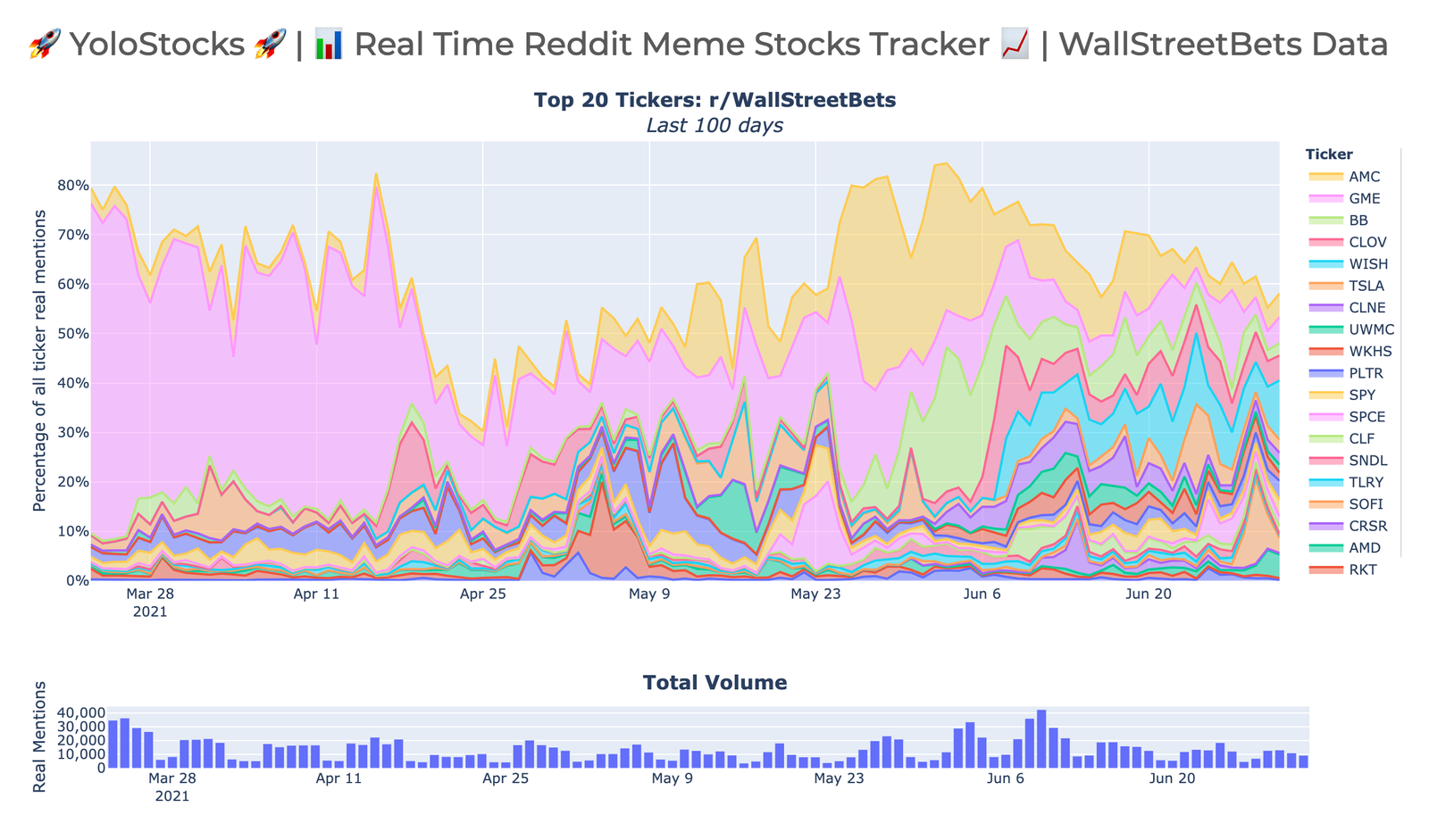

If your perception of Reddit’s r/WallStreetBets (WSB) is frozen in January 2021—a chaotic digital colosseum of “apes” yelling at pixelated rocket ships and sending GameStop stock to the moon—you’re missing the bigger, and arguably more significant, story. The subreddit, once universally dismissed by financial media as a carnival of reckless gamblers, has undergone a profound, albeit messy, evolution.
The vernacular remains, a defiant badge of honor. Users still proudly self-identify as “retards” and “degenerates,” and loss porn (showcasing disastrous trades) is still a celebrated genre. But beneath the abrasive, meme-laden surface, a more sophisticated and consequential current is flowing. The collective that once weaponized boredom-induced YOLO (You Only Live Once) trades into a short-squeeze phenomenon is now quietly, and with increasing frequency, placing macro bets.
This is the story of how WSB is transitioning from a mob of meme stock traders to a dispersed, often brilliant, and always volatile hive mind of macro-regarded strategists. It’s a shift from betting on a single company’s turnaround to wagering on the direction of entire economies, interest rates, and global geopolitical events. This journey from “retards” to “regarded” (a term of endearment in the community for someone whose seemingly insane bet is backed by deep, if unorthodox, research) is reshaping not only the community itself but also the way retail investors interact with the most complex layers of the financial world.
Part 1: The Anatomy of a Metamorphosis
The shift didn’t happen overnight. It was forged in the crucible of the post-meme-stock era, driven by a combination of market forces, collective experience, and the inherent limitations of the original playbook.
1.1 The Meme Stock Hangover
The explosive success of the GameStop and AMC short squeezes was a Pyrrhic victory for many. While some early entrants made life-changing money, countless others FOMO’d in at the peak, only to be left holding the bag as the stocks inevitably corrected. This created a collective wariness. The playbook was now known to everyone—including the hedge funds, who adapted their strategies to avoid being caught in such squeezes again.
The “easy money” was gone. Piling into heavily shorted, low-float stocks became a crowded and less reliable trade. The community needed a new frontier.
1.2 The Macro Catalyst: An Unignorable Environment
Just as the meme stock mania was cooling, the global macroeconomic landscape began to shift seismically. The era of near-zero interest rates and quantitative easing, which had defined the preceding decade, came to a screeching halt. Inflation, a ghost many younger investors had never encountered, returned with a vengeance.
The Federal Reserve embarked on the most aggressive interest rate hiking cycle in a generation. Bond markets, once a sleepy corner of finance, became a rollercoaster. Geopolitical events like the war in Ukraine and tensions with China began to directly dictate market movements.
You could no longer simply pick a “good company” and expect it to go up. The tide of cheap money had receded, and the brutal, underlying currents of macroeconomics were now exposed. For the analytically minded users of WSB, this wasn’t a deterrent; it was the ultimate challenge.
1.3 The Rise of the “DD” Culture
At the heart of this evolution is the “Due Diligence” or “DD” post. Even during the meme stock frenzy, the most revered posts were not just memes, but lengthy, well-researched deep dives into a company’s fundamentals, short interest, and potential catalysts. This culture of deep research seamlessly translated to the macro world.
Today, the top posts on WSB are frequently monumental treatises on:
- The Term Structure of Interest Rates: Analyzing the yield curve for signals of recession.
- Federal Reserve Policy: Parsing every word from Jerome Powell and modeling future rate hike probabilities.
- Inflation Dynamics: Differentiating between CPI, PCE, and core inflation, and debating their stickiness.
- Currency Markets (Forex): Speculating on the EUR/USD or USD/JPY pairs based on interest rate differentials.
- Government Bond Yields: Trading TLT (long-term treasury ETF) or betting on the direction of the 10-year note.
The language is still laced with profanity and self-deprecating humor, but the content is often graduate-level financial analysis. The “regarded” moniker is now earned not by blind faith, but by demonstrating a superior, if niche, understanding of a complex macroeconomic variable.
Part 2: The New Arsenal – Trading the Macro Playbook
So, how is this theoretical shift manifesting in actual trades? The WSB crowd, true to its nature, favors leveraged, high-risk instruments to express its macro views. The playground has moved from single-name equities to a broader set of tools.
2.1 The Weapon of Choice: Options on ETFs
The average retail investor cannot directly trade complex interest rate swaps or easily short the entire bond market. But they can trade options on Exchange-Traded Funds (ETFs) that track these assets. This has become the primary vehicle for WSB’s macro bets.
- SPY/QQQ Options: While always popular, the thesis behind these trades has evolved. It’s no longer just “stocks go up.” Now, posts detail intricate strategies like “theta gang” selling (collecting premium) in a sideways market, or buying puts based on a specific Fed meeting outcome or CPI print.
- TLT/TBT Options: The iShares 20+ Year Treasury Bond ETF (TLT) and the UltraShort 20+ Year Treasury ETF (TBT) have become staples. A user with a strong conviction that long-term yields will rise (and bond prices fall) might buy put options on TLT or call options on TBT. The comment sections of these posts are filled with debates over duration risk and the Fed’s reaction function.
- UUP/UDN Options: For bets on the U.S. dollar, the Invesco DB US Dollar Index Bullish Fund (UUP) is the go-to. A hawkish Fed view translates to a strong dollar thesis, leading to call options on UUP.
- Sector Rotation via ETFs: Instead of picking one oil stock, users will trade the Energy Select Sector SPDR Fund (XLE). Instead of gambling on a single bank, they’ll trade the Financial Select Sector SPDR Fund (XLF), which is highly sensitive to interest rate changes.
2.2 The 0DTE Phenomenon: A Micro-Macro Fusion
The rise of 0-Day-To-Expiration (0DTE) options represents a fascinating fusion of WSB’s degenerate roots with its new macro focus. These are options that expire on the same day they are traded.
This allows traders to make ultra-short-term bets on macroeconomic events. A hot CPI report is released at 8:30 AM EST? By 8:35, thousands of users are placing 0DTE puts on SPY, betting the market will sell off for the rest of the day. A dovish comment from a Fed official? 0DTE calls are bought en masse.
It’s high-speed, high-stakes gambling, but the catalyst is no longer a Elon Musk tweet; it’s the most consequential macroeconomic data point of the day. This represents a significant maturation of the trigger mechanism, even if the execution timeframe remains wildly reckless.
2.3 The “Meme-ification” of Macro
True to its identity, WSB has “meme-ified” macroeconomics. Complex concepts are broken down into digestible, often hilarious, formats.
- Jerome Powell Memes: The Fed Chairman is a constant figure, depicted as a market-wrecking god or a hesitant bureaucrat.
- CPI Print Reactions: The release of the Consumer Price Index is treated with the anticipation of a major sporting event, with live threads and instant analysis.
- “Bond Vigilante” LARPing: Users ironically role-play as “bond vigilantes,” threatening to sell their imaginary bond holdings to discipline the government.
This process of meme-ification is crucial. It democratizes complex information, making it accessible and engaging for a audience that would otherwise be intimidated by dry financial reports.
Part 3: Case Studies in “Regarded” Macro Genius
To understand this shift in practice, let’s examine two recent, high-profile examples where WSB’s macro hive mind was demonstrably ahead of the curve.
Case Study 1: The Regional Bank Collapse of 2023 (Silicon Valley Bank)
Long before Silicon Valley Bank (SVB) became a headline on every major news network, deep within the comment threads and dedicated DD posts on WSB, the bank’s demise was being predicted.
The Thesis: Astute users were digging into the quarterly reports of banks like SVB, First Republic, and Signature Bank. They identified a fatal flaw: during the era of near-zero interest rates, these banks had loaded up on long-dated Treasury and mortgage-backed securities. When the Fed began its rapid rate hikes, the market value of these “safe” assets plummeted.
Meanwhile, the banks’ deposit base—heavily concentrated in tech startups—was burning through cash. Users correctly foresaw a deadly squeeze: to meet withdrawal demands, the banks would have to sell their underwater bonds, realizing massive losses and sparking a crisis of confidence.
The Trade: While the world was focused on tech stocks, WSB users were buying put options on KRE (the SPDR S&P Regional Banking ETF) and specific regional bank stocks. The posts were filled with detailed analysis of unrealized loss percentages on bank balance sheets and deposit flight risk. When the collapse finally happened, it was a validation of this “regarded” research. These users weren’t lucky; they were right.
Case Study 2: The “Higher for Longer” Fed Pivot
Throughout much of 2023, the market narrative was dominated by the anticipation of a “Fed pivot”—the moment the central bank would stop hiking rates and begin cutting them. This hope fueled a massive rally in growth stocks, particularly tech.
However, a vocal and well-researched contingent on WSB consistently pushed back against this narrative. Their “DD” posts argued that inflation was proving far stickier than the market believed, driven by persistent services inflation and wage growth. They contended that the Fed would be forced to hold rates “higher for longer,” and that the market’s optimism was misplaced.
The Thesis: This group pointed to core CPI components like shelter and owner’s equivalent rent, arguing they would decline much more slowly than anticipated. They also highlighted strong employment data as a reason the Fed couldn’t afford to pivot prematurely.
The Trade: This manifested in strategic short positions on the NASDAQ (via puts on QQQ) and continued bearish bets on long-dated Treasuries (puts on TLT). While the market often rallied on hope, this group consistently faded the rallies, betting that macroeconomic reality would eventually reassert itself. Their persistence paid off repeatedly as “hot” inflation and jobs data would routinely dash market hopes, causing the rallies to fizzle and their bearish positions to profit.
Read more: Income Investors’ Dream: 4 U.S. Stocks with Rock-Solid Dividend Payouts
Part 4: The Double-Edged Sword – Risks and Ramifications
This evolution is not without its significant perils. Applying WSB’s high-risk, high-leverage mentality to the complex world of macroeconomics is like putting a jet engine on a go-kart.
4.1 Amplified Systemic Risk
The meme stock frenzy was largely contained to a handful of equities. Macro bets, by their nature, are tied to the entire financial system. A massive, coordinated retail bet against the bond market via leveraged derivatives, while unlikely to break the market alone, can contribute to volatility and exacerbate flash crashes. The 0DTE phenomenon, in particular, has drawn concern from regulators and institutional players for its potential to create intraday market instability.
4.2 The Dunning-Kruger Effect in Overdrive
Macroeconomics is famously known as the field where “experts have predicted nine of the last five recessions.” Its inherent complexity and unpredictability mean that even the most brilliant economists are often wrong.
The danger for the intelligent, yet inexperienced, WSB user is the Dunning-Kruger effect—a cognitive bias where people with limited knowledge overestimate their understanding. A user who correctly predicted one event (like the regional bank crisis) may develop an inflated sense of their own forecasting ability, leading them to take on catastrophic risk on a future, more complex trade. The line between “regarded” and just plain “retarded” is perilously thin and often only visible in hindsight.
4.3 The Unchanged Core of WSB: Life-Altering Losses
Despite the sophisticated analysis, the core culture of WSB still glorifies the YOLO. A well-researched, 5000-word DD on the term structure of the yield curve is often followed by a comment from the author: “Anyway, I just put my entire net worth into 0DTE SPY puts. See you at the Wendy’s dumpster.”
The tools have changed, but the appetite for risk remains self-destructively high. Life-altering financial losses are still a common and celebrated outcome. Applying this level of risk to the volatile world of macro trading can, and does, lead to financial ruin at a much faster pace than meme stocks ever could.
Part 5: The Future of the “Regarded” Hive Mind
Where does this evolution lead? The trend suggests WSB’s influence will become more nuanced and deeply embedded in the market fabric.
- Political and Fiscal Scrutiny: As the community becomes more macro-aware, its attention is inevitably turning from the Fed to the U.S. Treasury and Congress. Deep dives on the national debt, the debt ceiling, and fiscal policy are becoming more common. The “bond vigilante” role-playing may evolve into genuine, collective action that influences government bond auctions.
- Global Macro Expansion: The focus is still predominantly on the U.S. economy. The next frontier is likely deeper forays into European and Asian macro, trading instruments tied to the ECB, BOJ, and PBOC policies.
- A New Generation of Retail Investors: WSB is inadvertently creating a generation of retail investors with a surprisingly sophisticated understanding of monetary policy and global finance. While many will blow up their accounts, the survivors will emerge as a formidable, decentralized force—a true “dumb money” that is, in many cases, smarter than the “smart money” gives it credit for.
Conclusion: The Apes Have Learned Calculus
The journey of WallStreetBets from a fringe forum to a macro-aware powerhouse is one of the most fascinating developments in modern finance. It is a story of collective learning, adaptation, and the democratization of high-level financial strategy, all wrapped in a package of memes, profanity, and breathtaking recklessness.
They have not shed their skin; the chaotic, degenerate spirit of WSB is very much alive. But it has been fused with a newfound intellectual rigor. The “apes” who once communicated in rocket emojis are now casually discussing the nuances of the Secured Overnight Financing Rate (SOFR).
The financial establishment would be foolish to continue dismissing them as a mere mob. They are a chaotic, unpredictable, but increasingly “regarded” hive mind that has learned to speak the language of central banks and trade the pulse of the global economy. They are no longer just throwing rocks from the outside; they are inside the castle, and they’ve learned how the levers work. The question is no longer if they will cause another stir, but which part of the financial system they will try to move next.
Read more: Beyond the Magnificent Seven: 5 Undervalued U.S. Stocks Flying Under the Radar
Frequently Asked Questions (FAQ)
Q1: What does “regarded” mean in the context of WallStreetBets?
A: On WSB, “regarded” is an intentional misspelling of “retarded,” used as a term of ironic endearment. It describes a user whose trade idea or analysis seems insane or overly complex on the surface but is actually backed by deep, well-researched due diligence. Calling a detailed macro thesis “regarded” is a high form of praise.
Q2: I’m new to this. How can I start understanding macroeconomics without getting overwhelmed?
A: The WSB method is immersion. Start by reading the top “DD” posts, even if you don’t understand all the terms. Use Investopedia or other resources to look up concepts like “yield curve,” “quantitative tightening,” or “CPI.” Follow the discussions in the daily threads when major economic data is released. It’s a steep learning curve, but the community’s meme-ified breakdowns can be a surprisingly effective, if unorthodox, educational tool.
Q3: Is this shift making WSB a more responsible or safer place for investing?
A: Absolutely not. The increased sophistication of the analysis does not equate to decreased risk. In fact, by moving into complex, leveraged instruments like options on bonds and indices, the potential for rapid, catastrophic losses is even greater. WSB remains a high-risk environment that should be approached as a source of entertainment and education, not legitimate financial advice. Never risk more than you are willing to lose.
Q4: How can the “DD” on WSB be trusted, given the anonymous nature of the platform?
A: It shouldn’t be trusted blindly. The key is to scrutinize the “DD” yourself. Look for posts that provide verifiable data, cite their sources, and logically walk through their thesis. The top comments often serve as a peer-review system, picking apart flaws in the argument. Trust must be earned by the poster’s demonstrated track record and the quality of their reasoning, not their anonymous credentials.
Q5: What are some of the most common ETFs and tickers discussed for macro bets on WSB?
A: Common instruments include:
- SPY/QQQ: For overall market and tech sentiment.
- TLT/TBT: For bets on long-term interest rates (Treasury bonds).
- UUP: For bets on the strength of the U.S. dollar.
- XLF: For bets on the financial sector (highly rate-sensitive).
- VXX/UVXY: For bets on market volatility (these are complex and notoriously risky).
Q6: Has the community’s sentiment towards the Federal Reserve changed?
A: Yes, dramatically. During the meme stock era, the Fed was a distant, irrelevant entity. Now, Fed Chairman Jerome Powell is a central, almost mythologized figure. WSB is intensely focused on every word from the FOMC. The sentiment is often a mix of resentment, for disrupting the easy-money era, and a grudging respect for his power over markets.
Q7: Are institutional investors and hedge funds paying attention to this shift?
A: Increasingly, yes. While many initially dismissed WSB as a curiosity, the predictive power demonstrated during events like the regional bank crisis has forced them to take notice. Quantitative hedge funds now scrape and analyze data from the subreddit, not just for sentiment on meme stocks, but for emerging narratives on interest rates and inflation. WSB has become a non-traditional data point in the market ecosystem.