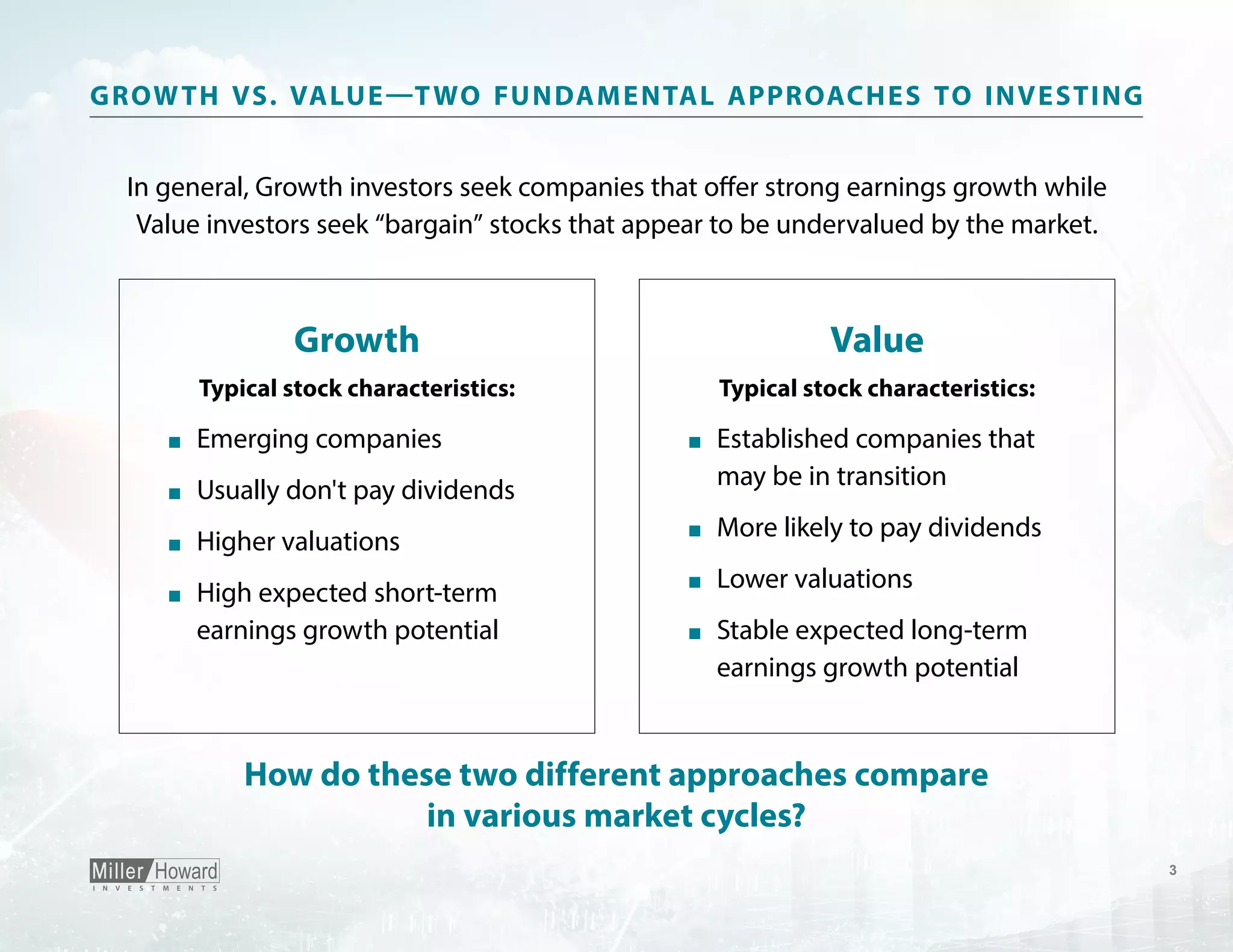
The rivalry between Value and Growth investing is one of the most enduring and debated topics in finance. For decades, investors have aligned themselves with one camp or the other, often based on deeply held philosophical beliefs about how markets work. Value investors, following the legacy of Benjamin Graham and Warren Buffett, seek to buy dollars for fifty cents—hunting for companies trading below their intrinsic worth. Growth investors, inspired by the likes of Philip Fisher and T. Rowe Price, are willing to pay a premium for companies whose earnings are expected to grow at an above-average rate, betting on future potential rather than present-day bargains.
The performance of these two styles is notoriously cyclical. There are long periods where one dramatically outperforms the other, followed by a painful and often swift reversal. The past decade, culminating in 2021, was largely a golden age for Growth, driven by ultra-low interest rates and the dominance of mega-cap technology stocks. However, the market shift that began in 2022, fueled by soaring inflation and aggressive Federal Reserve tightening, served as a stark reminder that no trend lasts forever. Value stocks staged a powerful comeback, leaving many Growth investors reeling.
In this dynamic and uncertain environment, a dogmatic adherence to a single style can be perilous. Instead, a disciplined, quantitative screening approach offers a more nuanced and potentially profitable path forward. This article will dissect the current US market cycle, define Value and Growth through a quantitative lens, and provide a practical framework for building and maintaining a screening process to identify the most compelling opportunities in either camp. By moving beyond narrative and sentiment, investors can harness data to make informed, unemotional decisions at a critical market juncture.
Part 1: Understanding the Current Macroeconomic Regime
To understand why the Value vs. Growth cycle has turned, we must first analyze the macroeconomic forces that act as the primary drivers.
1.1 The Interest Rate Paradigm
Interest rates are the most critical variable in the Value-Growth equation. Their effect can be understood through the lens of a discounted cash flow (DCF) model, which values a company based on the present value of its future cash flows.
- Growth Stocks: These companies are characterized by the majority of their expected cash flows lying far in the future. A high-growth tech company, for instance, might be investing heavily today for profits that may materialize in 5, 10, or 15 years. When discounting these distant cash flows back to their present value, a higher interest rate (the “discount rate”) dramatically reduces their value. Think of it as financial gravity; the stronger it is, the harder it is for lofty, long-duration assets to stay aloft.
- Value Stocks: These are typically mature companies generating stable, predictable cash flows in the near term. Think of a consumer staples giant or an industrial conglomerate. Because their cash flows are more immediate, they are less severely discounted by rising rates. Furthermore, many value stocks, such as those in the financial sector (banks, insurance), actually benefit from higher rates, as they can earn a wider spread on their core lending and investment activities.
The period from the 2008 Financial Crisis to 2021 was defined by historically low, and even zero, interest rates. This environment was a tailwind for Growth stocks, as the low discount rate made their long-dated cash flows exceptionally valuable. The paradigm shift toward quantitative tightening and rapid rate hikes that began in 2022 inverted this dynamic, creating a powerful headwind for Growth and a supportive environment for Value.
1.2 Inflation and Economic Cycles
Inflation and the stage of the economic cycle are deeply intertwined with style performance.
- Late-Cycle/High-Inflation Environment: We are currently in a period of persistent, albeit cooling, inflation and late-cycle economic dynamics. In such an environment, pricing power is paramount. Value sectors like energy, materials, and industrials often possess this pricing power, allowing them to pass on increased costs to consumers. Their revenues and earnings can keep pace with or even outpace inflation.
- Early-Cycle/Recovery Environment: During an economic recovery, Growth stocks often lead as investors anticipate expanding corporate earnings and are willing to take on more risk. However, in a late-cycle environment marked by fears of a slowdown or recession, investors often rotate toward the perceived safety and tangible earnings of Value stocks.
The current “higher for longer” interest rate narrative from the Fed, coupled with resilient but slowing economic data, creates a complex backdrop. It is not the unequivocal “Value” environment of 2022, nor is it a return to the “Growth-at-any-price” era of 2021. This ambiguity is precisely why a quantitative screen is so valuable—it can identify strength within both styles.
Part 2: Defining Value and Growth Quantitatively
Before we can screen for stocks, we must define our terms with mathematical precision. Relying on subjective labels is a common pitfall; a quantitative approach eliminates this ambiguity.
2.1 Core Quantitative Value Metrics
Value investing is fundamentally about buying a business for less than it is worth. The following metrics help quantify that discount.
- Price-to-Earnings (P/E) Ratio: The most widely known valuation metric. P/E = Share Price / Earnings Per Share (EPS). A low P/E relative to the market or the stock’s own history can indicate undervaluation. However, it must be used cautiously, as depressed earnings can artificially inflate the ratio.
- Price-to-Book (P/B) Ratio: This compares a company’s market value to its accounting (book) value. P/B = Market Capitalization / Book Value of Equity. A P/B below 1.0 suggests the market is valuing the company for less than the net value of its assets—a classic value signal. It is particularly relevant for asset-heavy businesses like banks and industrials.
- Enterprise Value to EBITDA (EV/EBITDA): A more comprehensive metric. Enterprise Value (EV) includes debt, making it useful for comparing companies with different capital structures. EBITDA (Earnings Before Interest, Taxes, Depreciation, and Amortization) is a proxy for operating cash flow. A low EV/EBITDA indicates a company is generating strong operational cash flow relative to its total purchase price.
- Price-to-Free-Cash-Flow (P/FCF): Often considered a superior metric to P/E because free cash flow is harder to manipulate with accounting practices. P/FCF = Market Cap / Free Cash Flow. It shows how much the market is paying for every dollar of cash the company generates, which can be used for dividends, buybacks, or reinvestment.
- Shareholder Yield: A holistic measure of what a company returns to shareholders. It is calculated as Dividend Yield + Buyback Yield. A high shareholder yield indicates a management team committed to returning capital to owners, a common trait in value-oriented firms.
2.2 Core Quantitative Growth Metrics
Growth investing focuses on future potential. The key is to identify companies with strong and sustainable expansion trajectories.
- Earnings Per Share (EPS) Growth: The year-over-year (YoY) percentage change in EPS. Consistent high EPS growth (e.g., >15-20%) is a primary target. It’s important to look at both historical (last 3-5 years) and forecasted growth.
- Revenue (Sales) Growth: YoY percentage change in top-line sales. Strong revenue growth indicates rising demand for a company’s products or services, independent of accounting or cost-cutting measures. It’s a purer measure of business momentum.
- Free Cash Flow (FCF) Growth: The YoY percentage change in FCF. For many growth investors, this is even more critical than earnings growth, as it represents the actual cash being generated to fund future expansion without external financing.
- Return on Equity (ROE): A measure of profitability and efficiency. ROE = Net Income / Shareholder’s Equity. A high and/or improving ROE indicates that management is effectively using the capital invested in the business to generate profits. A growth company should demonstrate superior returns on capital.
Part 3: Building a Quantitative Screening Framework
With our metrics defined, we can now construct a systematic process for identifying potential Value and Growth candidates. This process moves from the broad market down to individual company analysis.
Step 1: Universe Selection and Data Sources
First, define your investment universe. For a US-focused screen, this is typically the Russell 3000 index, which represents ~98% of the investable US equity market. This provides a broad pool of large, mid, and small-cap stocks.
You will need access to a robust financial screening tool. Platforms like Bloomberg, FactSet, and Refinitiv Eikon are institutional standards. For sophisticated individual investors, services like YCharts, Morningstar Premium, Finviz, and TradingView offer powerful screening capabilities.
Step 2: Constructing the Value Screen
The goal is to find companies that are statistically cheap across multiple dimensions, not just on a single metric. A composite approach is more robust.
Sample Quantitative Value Screen:
- P/E Ratio: < 15x (lower than the S&P 500 historical average)
- P/B Ratio: < 1.5x
- EV/EBITDA: < 10x (sector-dependent, but a good general threshold)
- Dividend Yield: > 2% (optional, but adds an income component)
- Debt-to-Equity Ratio: < Industry Average (avoids “value traps” with dangerous debt levels)
This initial screen will produce a list of statistically cheap companies. However, cheapness alone is not enough. We must avoid “value traps”—companies that are cheap for a reason and likely to stay that way.
Value Trap Avoidance Filters:
- Positive EPS Growth (YoY): Ensures the business isn’t in terminal decline.
- Positive Free Cash Flow: Confirms the company is generating real cash.
- ROE > 8%: Filters for companies with at least modest profitability.
Step 3: Constructing the Growth Screen
Here, we seek companies with superior growth metrics, but we must be wary of overpaying for that growth.
Sample Quantitative Growth Screen:
- EPS Growth (YoY): > 15%
- Revenue Growth (YoY): > 10%
- ROE: > 15% (indicates high-quality, profitable growth)
- Free Cash Flow Growth (YoY): > 10%
Again, a raw screen is just the start. We must apply quality and valuation sanity checks to avoid “story stocks” with unsustainable valuations.
Growth Quality & Valuation Filters:
- P/E to Growth (PEG) Ratio: < 1.5. The PEG ratio (P/E / EPS Growth Rate) is a crucial metric for growth investors. A PEG below 1.0 is considered excellent, indicating you are paying less for each unit of growth. A threshold of 1.5 helps screen out egregiously overpriced names.
- Profit Margin > Industry Average: Indicates a strong business model and pricing power.
- Balance Sheet Check: Debt-to-Equity < Industry Average. High-growth companies often use debt, but excessive leverage is a red flag, especially in a rising-rate environment.
Part 4: Applying the Screen to the Current Market
Let’s apply our framework conceptually to the current market landscape (data is illustrative and as of the general timeframe of late 2023/early 2024).
4.1 The Value Landscape: Where the Screen Points
A current Value screen is likely to be heavily populated by specific sectors:
- Financials: Banks and insurance companies often trade at low P/B and P/E ratios. With high interest rates, their net interest income is robust. A screen for P/B < 1.2 and a stable or growing loan book would highlight potential candidates here.
- Energy: After a strong run, some energy companies may still screen as value based on P/E and FCF metrics, especially if oil prices stabilize at a profitable level. Their massive free cash flow generation leads to high shareholder yields via dividends and buybacks.
- Industrials & Materials: Companies in these sectors often have tangible assets and stable cash flows. A screen for EV/EBITDA < 9 and ROE > 12% could uncover well-run industrial names that are priced reasonably.
- Select Healthcare: Mature pharmaceutical and healthcare services companies, with their reliable cash flows and high dividends, often appear on value screens.
The Key Insight: The screen forces you to look at sectors the market narrative may be ignoring. While headlines focus on AI, a quantitative value approach systematically uncovers companies generating real profits and cash today, often at a significant discount.
4.2 The Growth Landscape: Finding Sustainable Growth at a Reasonable Price
The Growth screen today is dominated by, but not exclusive to, technology.
- Semiconductors (Tech): The engines of the AI revolution. A growth screen for EPS Growth > 20% and ROE > 20% would heavily feature this sub-sector. The critical filter is the PEG ratio. Many semiconductor stocks have high P/Es, but if their growth justifies it (PEG < 1.5), they remain quantitatively sound.
- Software (SaaS): While many were hammered in 2022, the highest-quality software companies with durable competitive advantages (high margins, recurring revenue) are starting to screen well again as growth stabilizes. Look for Revenue Growth > 15% and positive (or rapidly improving) FCF.
- Consumer Discretionary: Companies linked to experiential spending and e-commerce may appear if they can demonstrate resilient growth in the face of economic uncertainty.
- Healthcare (Biotech): Smaller biotech firms with promising drug pipelines can show up on revenue growth screens, but they carry high binary risk and require deep due diligence beyond the numbers.
The Key Insight: A modern growth screen is not just about the highest growth rate. It’s about profitable, high-return growth that is not excessively priced. The PEG ratio is the essential tool for navigating this space today, preventing overexposure to the most speculative names.
Part 5: The Hybrid Approach: Blending Value and Growth
The most compelling opportunities often lie at the intersection of styles. This is the domain of GARP (Growth At a Reasonable Price), a philosophy pioneered by Peter Lynch.
A GARP screen directly incorporates the metrics we’ve discussed:
- PEG Ratio: Between 0.8 and 1.5 (seeking growth but penalizing overpayment)
- EPS Growth: Between 10% and 20% (seeking sustainable growth, not hyper-growth)
- P/E Ratio: Below the market average or industry average
- Consistent Revenue and Earnings Growth: Over the last 3-5 years.
In the current market, a GARP approach is particularly powerful. It allows investors to participate in the growth stories of the future without abandoning the discipline of value investing. It systematically avoids both the value traps of dying industries and the speculative bubbles of profitless growth.
Read more: Top 5 Penny Stocks on the NASDAQ & NYSE to Watch This Quarter
Part 6: Implementation, Portfolio Construction, and Risk Management
Identifying stocks is only half the battle. Implementation is key.
- Due Diligence is Non-Negotiable: A quantitative screen is a starting point for further research, not the end. You must investigate the qualitative factors:
- Competitive Advantage (Moat): What protects this company from competitors?
- Management Quality: Are capital allocators skilled and aligned with shareholders?
- Industry Tailwinds/Headwinds: What are the secular trends affecting the sector?
- ESG Considerations: For many investors, Environmental, Social, and Governance factors are an integral part of risk assessment.
- Portfolio Construction:
- Diversification: Do not concentrate your portfolio in a single style or sector, even if your screen points you there. Allocate across both Value and Growth, and across multiple sectors.
- Position Sizing: Size positions based on conviction and risk. A statistically cheap value stock may warrant a larger position than a more speculative growth candidate.
- Rebalancing: The market cycle will change. A disciplined investor uses their screening process quarterly or semi-annually to rebalance the portfolio, trimming positions that no longer meet the criteria and adding new ones that do.
- Behavioral Pitfalls:
- Confirmation Bias: Do not ignore when a screen shows your favorite stock is overvalued.
- Recency Bias: Do not assume the recent past (e.g., Growth dominance) will continue indefinitely.
- Anchoring: Be willing to update your thesis and sell a position if the quantitative data changes.
Conclusion: Navigating the Cycle with Data and Discipline
The debate between Value and Growth is not a war to be won, but a cycle to be navigated. The current US market cycle, characterized by higher interest rates, persistent inflation, and economic uncertainty, has shifted the balance of power toward Value. However, pockets of high-quality, reasonably-priced Growth continue to offer compelling opportunities.
A rigid, ideological approach is ill-suited for this environment. The quantitative screening methodology outlined here provides a systematic, unemotional, and repeatable process for identifying potential investments in either camp. By defining your criteria, building a robust screen, applying rigorous quality and valuation filters, and conducting thorough due diligence, you can cut through market noise and build a resilient portfolio.
The goal is not to predict the future but to prepare for it. By using data as your guide, you can position yourself to find value where it exists and growth where it is sustainable, regardless of which style the market favors next.
Read more: The SEC’s Red Flags: How to Spot Penny Stock Scams and Pump-and-Dumps
Frequently Asked Questions (FAQ)
Q1: Is Value or Growth better for the long term?
Historically, value investing has shown a slight long-term performance premium in many academic studies (e.g., the Fama-French research). However, these cycles can last for a decade or more. The “long term” is made up of many different shorter-term cycles. A disciplined investor may be best served by maintaining exposure to both, perhaps tilting their allocation based on the prevailing macroeconomic regime identified through a quantitative framework.
Q2: What is a “value trap” and how can I really avoid it?
A value trap is a stock that appears cheap based on traditional metrics (low P/E, low P/B) but is actually in secular decline. Its low price is a permanent state, not a temporary discount. To avoid them, your quantitative screen must include “quality” or “vitality” filters:
- Check for declining revenue and earnings over several years.
- Ensure the company has positive and growing free cash flow.
- Look at the debt level; a highly leveraged company in a declining industry is a prime value trap candidate.
- Assess the industry’s long-term prospects—is it being disrupted by technology?
Q3: How important are interest rates for this strategy?
They are critically important, as explained in Part 1. Interest rates are the primary transmission mechanism between the economy and the relative performance of Value vs. Growth. A quantitative screen is not run in a vacuum; you must interpret the results in the context of the rate environment. In a rising rate environment, your value screen will likely be more fruitful, and your growth screen will require stricter PEG ratio filters.
Q4: Can I implement this strategy using only free tools?
Yes, to a significant degree. While institutional platforms like Bloomberg offer the most power, retail investors can use a combination of free and premium tools effectively.
- Free Screens: Finviz (free version), Yahoo Finance, and TradingView offer basic screening capabilities.
- Data for Due Diligence: Company financials are available for free on SEC EDGAR (10-K, 10-Q reports).
The limitations of free screens are usually the number of metrics you can combine at once and the depth of historical data. A low-cost premium subscription to a service like Finviz Elite or StockRover can be a worthwhile investment for a serious investor.
Q5: How often should I run my screens?
For a long-term investor, running a full quantitative screen quarterly is a good balance between being proactive and avoiding over-trading. This aligns with corporate earnings cycles, ensuring you are working with the most recent financial data. Running it more frequently may lead to reacting to short-term noise rather than fundamental changes.
Q6: What is the single most important metric in your framework?
There isn’t one. The power of this approach lies in the combination of metrics. However, if forced to choose one for each style:
- For Value: EV/EBITDA is highly respected because it is capital-structure neutral and focuses on operational cash flow.
- For Growth: The PEG Ratio is indispensable because it contextualizes the high P/E within the framework of the company’s growth rate.
A holistic view, always considering multiple factors, is far superior to relying on any single number.