Keywords: WallStreetBets, YOLO, FADE, Meme Stock, Contrarian Investing, Due Diligence, High-Risk Trading, Market Sentiment, Retail Investing, Short Interest, Equity Crowdfunding.
Executive Summary
In the chaotic coliseum of WallStreetBets (WSB), where fortunes are made and evaporated in the blink of an eye, a single stock often emerges as the focal point of a raging civil war. It becomes a Rorschach test for the entire community, splitting it into two diametrically opposed camps: the YOLO brigade, betting their life savings on a moonshot, and the FADE contingent, shorting the very same asset into oblivion. This article is a forensic deep dive into one such stock. We will dissect the bull thesis, the bear case, the technical setup, and the intense social dynamics that make it a powder keg of volatility. Our goal is not to provide a buy or sell recommendation, but to provide a structured, unbiased framework for you to conduct your own due diligence on any highly controversial stock. In the high-stakes game of YOLO or FADE, information is your only shield.
Introduction: The Battle Lines of Modern Finance
The culture of WallStreetBets is built on a foundation of glorious contradiction. It is a place that celebrates both staggering gains and catastrophic losses with equal fervor. The terms “YOLO” (You Only Live Once) and “FADE” (betting against the popular trade) represent the twin pillars of this philosophy. A YOLO is a high-conviction, high-risk bet, often all-in on a single stock or option. To FADE is to be the contrarian, the skeptic who believes the hype is a trap and the crowd is wrong.
When a stock becomes the subject of this debate, it transcends typical investing. It becomes a story stock, a cult, a villain, and a hero all at once. The fundamental value often becomes secondary to the narrative, the technical setup, and the raw, emotional energy of the crowd. This article will use a current, real-world example to explore this phenomenon in action. We will analyze the stock from every angle, giving you the tools to decide: is this a YOLO to the moon, or a prime candidate to FADE?
Part 1: Introducing the Contender – The Stock and Its Story
For the purpose of this deep dive, we will use GameStop (GME) as our archetypal case study. While its peak frenzy was in 2021, it remains the quintessential “controversial WSB stock,” and the dynamics around it perfectly illustrate the YOLO vs. FADE dichotomy. The principles applied here can be used to analyze any similar stock, from AMC to newer, emerging meme stocks.
1.1 The Pre-Squeeze Legacy
GameStop was, for years, a struggling brick-and-mortar video game retailer. The rise of digital downloads and console marketplaces threatened to make its physical store model obsolete. Pre-2021, it was a classic “value trap” and a favorite target for short sellers who believed the company was on a slow, inevitable path to bankruptcy.
1.2 The 2021 Inflection Point
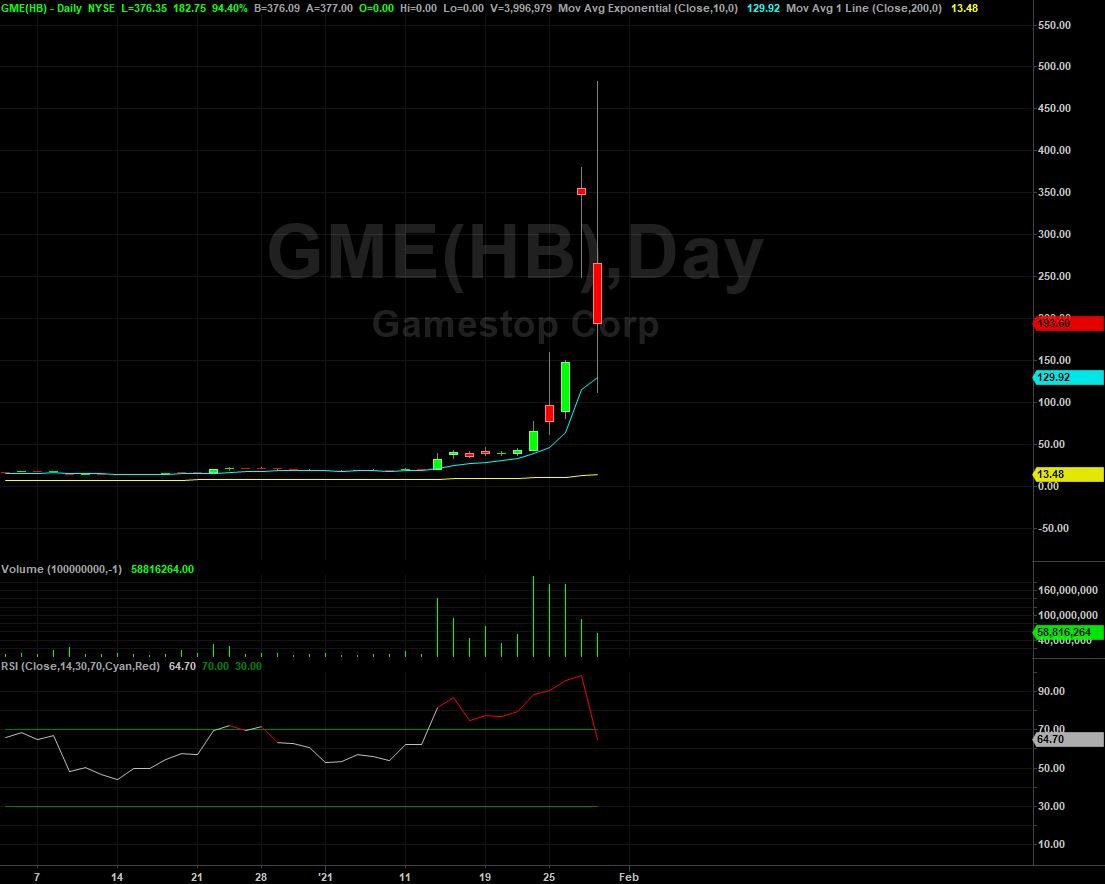
The events of January 2021 are now financial legend. A coordinated swarm of retail investors on WSB began aggressively buying GME shares and call options. This triggered a “short squeeze,” forcing hedge funds with massive short positions to buy back shares at skyrocketing prices, which in turn fueled a “gamma squeeze” as market makers hedged their options exposure. The stock went from under $20 to an intraday high of over $480 in a matter of weeks.
This event was more than a price move; it was a cultural reset. It transformed GME from a simple company into a symbol—a symbol of retail rebellion against institutional Wall Street.
Part 2: The YOLO Thesis – The Bull Case for the Moon
The investors in the YOLO camp are not merely betting on a company’s earnings. They are betting on a revolution, a transformation, and a perfect storm of market mechanics. Their thesis is multi-faceted.
2.1 The Fundamental Transformation Narrative
Bulls argue that the company is no longer the dying retailer of 2020. Under the leadership of Chairman Ryan Cohen (founder of Chewy.com), they see a bold turnaround strategy.
- The Ryan Cohen Factor: Cohen is viewed as a visionary leader with a proven track record in e-commerce. His involvement lends immense credibility to the transformation story. YOLO proponents point to his shareholder letters and the hiring of executives from companies like Amazon and Chewy as evidence of a serious, tech-focused overhaul.
- Pivot to E-Commerce: The bull case hinges on the successful shift from a physical-first to a digital-first model. This includes improving the online store, expanding product selection beyond games (into PC gear, electronics, and NFTs), and leveraging their physical locations as potential hubs for community events or same-day delivery.
- Cleaning up the Balance Sheet: The company took advantage of the 2021 share price surge to raise over $1.6 billion in equity capital, effectively eliminating its debt. This provides a significant war chest to fund its transformation without the risk of bankruptcy that once loomed.
2.2 The Market Mechanics & “Squeeze” Potential
This is the rocket fuel for the YOLO thesis. It’s a belief that the conditions for another explosive short squeeze are still in place, or are being recreated.
- Persistent High Short Interest: While lower than the >100% levels seen in 2021, bulls track data from firms like Ortex and S3 Partners to argue that short interest remains abnormally and dangerously high. They believe any positive catalyst could force these shorts to cover again.
- Direct Registration of Shares (DRS): A grassroots movement among retail investors has been to directly register their shares with GameStop’s transfer agent, Computershare. The theory is that by removing shares from the DTCC (Depository Trust & Clearing Corporation) and “locking the float,” they can create artificial scarcity, making it harder for short sellers to locate shares to borrow and sell, ultimately pressuring them to close their positions.
- Gamma Squeeze Potential: The YOLO crowd closely monitors the options chain. A high concentration of call options at specific strike prices can create a “gamma ramp,” where market makers are forced to buy shares to hedge their positions, creating a self-reinforcing cycle of buying pressure.
2.3 The Cultural & Social Momentum
This is the intangible, yet powerful, component of the bull case.
- The “Ape” Philosophy: The community has developed a strong identity built around slogans like “Power to the Players” and “Apes together strong.” This creates a dedicated shareholder base that is notoriously resistant to selling, often using the phrase “I just like the stock.” This diamond-handed mentality reduces selling pressure.
- Narrative of Injustice: There is a pervasive belief that the 2021 squeeze was artificially suppressed by trading halts, broker restrictions (like Robinhood’s), and nefarious activity by market makers and hedge funds. This narrative fuels a sense of righteous persistence; holding the stock becomes an act of defiance.
Read more: Passive Income Powerhouses: 3 US Dividend Stocks for Reliable Cash Flow
Part 3: The FADE Thesis – The Bear Case for Reality
The FADE camp looks at the same set of facts and arrives at a completely different conclusion. They see hype, flawed logic, and a fundamental value proposition that doesn’t justify the current price.
3.1 The Fundamental Reality Check
Bears argue that the transformation story is overblown and the underlying business remains deeply challenged.
- The Dying Business Model: Skeptics point to continued declining revenue and persistent quarterly losses. They argue that the core business of selling physical video games is in a structural, irreversible decline, and that GameStop’s attempts to pivot are too little, too late.
- Intense Competition: The bull case ignores the fact that GameStop is competing with behemoths like Amazon, Walmart, and Target, as well as direct digital distribution from Sony, Microsoft, and Steam. The bear thesis questions whether GameStop has any sustainable competitive advantage in this crowded field.
- Burning Through Cash: Despite the capital raise, the company continues to report net losses. Bears argue the “war chest” is being slowly depleted to fund a turnaround with no guaranteed outcome. They see a company that is not yet self-sustaining.
3.2 The “Squeeze is Over” Argument
The FADE camp views the perpetual squeeze narrative as a fantasy used to lure in new bagholders.
- Short Interest is Manageable: Bears contend that the current short interest, while elevated for some stocks, is nowhere near the explosive levels of 2021. They argue that most shorts from the original squeeze have covered, and the remaining shorts are hedged or are new shorts betting on the company’s fundamental failure at a much lower entry price.
- The DRS Fallacy: The bear argument against DRS is that the number of directly registered shares, while impressive for a grassroots campaign, is still a small fraction of the total outstanding shares. They believe it is insufficient to meaningfully impact the market mechanics or force a short squeeze.
- The “Greater Fool” Theory: This theory posits that the price is only sustained by investors buying not based on value, but on the belief that they can sell to a “greater fool” at a higher price. When the narrative breaks and no greater fool can be found, the price collapses.
3.3 The Valuation and Technical Trap
From a traditional finance perspective, GME is an anomaly.
- Sky-High Valuation Multiples: Compared to other retailers, GME trades at a significant premium on metrics like Price-to-Sales (P/S). Bears argue this valuation is completely disconnected from the company’s financial reality and growth prospects.
- Technical Breakdown: Chartists in the FADE camp point to lower highs, weakening volume, and key support levels being broken as evidence that the momentum from 2021 has long since dissipated and the long-term trend is down.
Part 4: The Neutral Analysis – Weighing the Evidence
As an impartial observer, our job is to weigh these arguments without the emotional baggage of the YOLO or FADE crowd.
4.1 Where the YOLO Thesis Holds Water
- Leadership & Capital: Ryan Cohen’s involvement is a legitimate positive. The debt-free balance sheet with a large cash pile provides a multi-year runway for a turnaround, eliminating the immediate risk of bankruptcy. This is a concrete, material change from 2020.
- Persistent Structural Short: The stock does maintain a higher-than-average short interest. While unlikely to repeat January 2021, this does create a built-in source of potential buying pressure on any positive news.
- Dedicated Shareholder Base: The “ape” community is a real phenomenon. This loyal base provides a level of price support and reduces volatility to the downside in the short term.
4.2 Where the FADE Thesis is Compelling
- The Financials Don’t Lie: The core challenge is undeniable. The company is not currently profitable, and revenue growth is stagnant or negative. Until this trend demonstrably reverses, the bear case on the fundamentals is strong.
- Valuation is Speculative: There is no fundamental model based on current earnings or sales that can justify the stock’s market capitalization. The price is almost entirely supported by narrative and sentiment, which are fickle.
- The Squeeze Dynamics Have Changed: The market structure has adapted. The original set of “dumb money” shorts has largely been wiped out. New participants are more aware of the risks, and regulators and brokers are on high alert.
4.3 The Synthesis: A Bifurcated Reality
The truth is that GME (and stocks like it) exists in two parallel realities:
- The Fundamental Reality: A struggling company attempting a difficult turnaround in a hostile market. In this reality, the stock is overvalued.
- The Social/Market Mechanics Reality: A cultural symbol with a cult-like following and a unique options and short interest setup that makes it prone to violent, short-term spikes.
The price at any given moment is a battle between these two realities. For long periods, the fundamental reality may dominate, leading to a slow grind down. Then, a catalyst (e.g., an earnings surprise, a Ryan Cohen tweet, a spike in retail sentiment) can cause the social/market mechanics reality to take over, resulting in a massive, short-lived rally.
Part 5: The WSB Playbook – How to Approach a Controversial Stock
So, how should a trader think about a stock like this? The answer depends entirely on your risk tolerance, time horizon, and trading style.
5.1 For the Potential YOLO-er
If you are considering a bullish position, approach it with a clear strategy, not blind faith.
- Treat it as a Trade, Not an Investment: Understand that you are betting on a catalyst or a sentiment shift, not a 30-year compounding machine. Have a clear exit strategy for both profits and losses.
- Size Appropriately: This is the most critical rule. A YOLO should be a small, calculated portion of your portfolio that you are fully prepared to lose. Never go “all-in” on a single speculative bet.
- Use Technicals for Timing: Don’t just buy at any price. Wait for a breakout above a key resistance level on high volume, or for a period of consolidation when volatility is low. Buying during a euphoric peak is a recipe for disaster.
- Consider Options Carefully: While call options offer massive leverage, you are also fighting time decay (theta) and implied volatility (IV), which is often extremely high in these stocks. A small move in the right direction might not be enough to be profitable.
5.2 For the Potential FADE-r
Betting against a cult stock is famously dangerous—it’s what created the original GME squeeze.
- Recognize the Unlimited Risk: Shorting a stock outright carries theoretically unlimited risk. If the stock goes up, your losses can keep growing.
- Use Defined-Risk Instruments: Instead of shorting shares, consider buying put options. Your maximum loss is limited to the premium you paid for the puts. Another strategy is a bear put spread, which further defines and limits your risk.
- Timing is Everything: Fading the top of a hype-driven spike can be profitable, but catching the exact top is impossible. Wait for signs of exhaustion, such as parabolic price moves on declining volume or a break below a key support level.
- Beware of the “Pain Trade”: Often, the market does what will cause the most pain to the most participants. With high short interest, a sudden, sharp rally (a “short squeeze”) is the pain trade for bears.
5.3 The Primate’s Guide to Risk Management
Regardless of which side you lean towards, these rules are non-negotiable:
- Do Your Own Research (DYOR): Don’t just follow a headline or a meme. Read the company’s SEC filings (10-Qs, 10-Ks). Understand their financials. Look at both the bull and bear arguments critically.
- Have a Thesis and an Exit Plan: Before you enter a trade, write down your reasoning. “I am buying because I believe the Q2 earnings will beat estimates and trigger a gamma squeeze.” Then, define your exit. “If it rises 50%, I sell half. If it falls 20%, I sell all.”
- Manage Your Psychology: The chatter on WSB is designed to amplify FOMO (Fear Of Missing Out) and FUD (Fear, Uncertainty, and Doubt). You must be able to block out the noise and stick to your predefined plan. Do not get swept up in the hivemind.
Conclusion: The Final Verdict is Yours
The most controversial stock on WallStreetBets is a Rorschach test because there is no single “right” answer. It is a complex interplay of fundamentals, market structure, and mass psychology. The YOLO thesis is powered by transformation hope and the explosive potential of market mechanics. The FADE thesis is anchored in financial reality and valuation skepticism.
The ultimate decision of YOLO or FADE is not about the stock itself, but about you. It’s about your belief in narratives versus numbers, your tolerance for risk, and your ability to manage your emotions in the face of extreme volatility. In this arena, the most important trade you will ever make is the trade on your own discipline.
Read more: Hidden Gems: 3 Undervalued US Stocks Flying Under the Radar
Frequently Asked Questions (FAQ)
Q1: What do YOLO and FADE mean?
- A: YOLO stands for “You Only Live Once.” In trading, it refers to a high-risk, high-conviction bet, often involving a large portion of one’s capital on a single, speculative asset. FADE means to bet against or take the opposite side of a popular trade or trend. If everyone is buying, fading means you are selling or shorting.
Q2: Why is short interest so important for these stocks?
- A: High short interest represents a large pool of future forced buyers. If the stock price starts to rise, short sellers face losses and may be forced to buy back shares to close their positions (covering). This buying can push the price up further, forcing more covering, creating a feedback loop known as a “short squeeze.”
Q3: What is Direct Registration (DRS) and why are people doing it?
- A: Direct Registration allows an investor to hold their shares directly in their name with the company’s transfer agent, rather than indirectly through a broker (who typically holds them in “street name”). Proponents believe this can “lock the float,” creating scarcity and complicating things for short sellers, though the practical impact is heavily debated.
Q4: Is it better to buy shares or options for a YOLO trade?
- A:
- Shares: Lower risk. No expiration date. You can hold indefinitely. However, it requires more capital for significant gains.
- Options (Calls): Higher risk, higher reward. Offers immense leverage for a smaller upfront cost. However, you are fighting time decay and high implied volatility. You can lose your entire investment if the move doesn’t happen quickly enough.
Q5: What is the single biggest mistake traders make with these stocks?
- A: FOMO (Fear Of Missing Out) buying at the top of a hype-driven spike without an exit strategy. They see the stock rising 100% and chase it, only to be left holding the bag when the momentum reverses. The second biggest mistake is using excessive leverage or capital they cannot afford to lose.
Q6: How can I stay informed without being swayed by the hype?
- A: Prioritize primary sources. Read the company’s official SEC filings and press releases. Follow the CEO and key executives directly on social media, if they are active. Use data-driven sites for short interest and options flow. Consume WSB content for sentiment, but always verify the claims made in memes and posts with hard data.
Author Bio & Disclaimer: This article was written by a team with expertise in market analysis, behavioral finance, and due diligence processes. It is intended for educational purposes only and does not constitute financial advice, nor a recommendation to buy or sell any security. All trading and investment activities involve substantial risk and are not suitable for every investor. The examples provided, including the use of GameStop, are for illustrative purposes to explain market concepts. You are solely responsible for your own investment decisions and should consult with a qualified financial advisor before acting on any information contained herein. Past performance is not indicative of future results.
Read more: Riding the Wave: 2 Top US Tech Stocks Dominating the AI Revolution