Executive Summary
After the most aggressive Federal Reserve tightening cycle in decades, the financial markets are now pivoting towards a new phase: the anticipation of interest rate cuts. This shift in monetary policy is not merely a macroeconomic event; it is a powerful catalyst that will reprice assets across the spectrum. While all stocks are influenced by the cost of capital, certain sectors are disproportionately sensitive to the direction of interest rates.
This article provides a deep-dive analysis into which US stocks stand to benefit most from a forthcoming easing cycle. We will explore the fundamental mechanics of how rate cuts impact different business models, identify the most rate-sensitive sectors—including Small-Caps, Real Estate (REITs), Financials, and Technology—and distinguish between short-term tactical opportunities and long-term strategic winners. Furthermore, we will provide a disciplined framework for evaluating individual companies within these sectors to avoid value traps and capitalize on genuine growth stories. For investors looking to position their portfolios for the next phase of the economic cycle, understanding this dynamic is paramount.
1. The Macro Backdrop: From Tightening to Easing
To understand where we’re going, we must first understand where we are. The post-pandemic inflation surge prompted the Federal Reserve to raise the federal funds rate from near-zero in March 2022 to a 23-year high of 5.25%-5.50% by July 2023. This was quantitative tightening (QT) in its purest form, designed to cool demand and bring inflation back to the 2% target.
As inflation has moderated—though the “last mile” has proven stubborn—the Fed’s focus has subtly shifted from solely combating inflation to a dual mandate that now includes monitoring employment and economic growth. The market’s anticipation of rate cuts is based on the belief that the Fed will act to:
- Prevent Overtightening: Ease monetary policy to avoid triggering an unnecessary recession.
- Normalize Policy: Move rates from a “restrictive” level back toward a “neutral” level as inflation abates.
- Manage Real Yields: As inflation falls, if nominal rates remain unchanged, real (inflation-adjusted) interest rates rise, which can be overly constrictive.
This impending shift is critical because interest rates are the “gravity” of the financial universe. When gravity decreases (rates fall), certain assets can float higher more easily.
2. The Fundamental Mechanics: How Rate Cuts Fuel Stock Performance
The transmission of interest rate changes into stock prices occurs through several key channels:
2.1 The Discount Rate Effect: Boosting Present Value
This is the most fundamental concept in finance. A stock’s price is the present value of its future cash flows. The discount rate is the interest rate used to calculate that present value.
- Higher Rates: Increase the discount rate, reducing the present value of future earnings, especially for long-duration assets (growth stocks with profits far in the future).
- Lower Rates: Decrease the discount rate, increasing the present value of those same future earnings. This provides a direct tailwind to valuation multiples (P/E ratios).
Example: A company projected to earn $10 per share in 10 years is worth about $38 today with a 10% discount rate. If the discount rate falls to 8%, that same future $10 is worth over $46 today—a 21% increase in present value without any change in the company’s fundamentals.
2.2 The Cost of Capital and Debt Refinancing
Companies run on capital. Lower interest rates directly reduce the cost of borrowing for:
- Funding Operations and Expansion: Cheaper debt makes it more attractive to invest in new projects, R&D, and mergers & acquisitions.
- Refinancing Existing Debt: Companies carrying variable-rate debt or facing maturing bonds can refinance at lower rates, boosting profitability by reducing interest expenses. This is particularly crucial for capital-intensive businesses.
2.3 The Consumer and Economic Stimulus
Lower interest rates reduce borrowing costs for consumers (mortgages, auto loans, credit cards) and increase the disposable income for those with variable-rate debt. This can stimulate consumer spending, which drives ~70% of the US economy, benefiting a wide swath of consumer-discretionary companies.
2.4 The Relative Attractiveness of Stocks
Fixed-income investments like bonds become less attractive when interest rates fall, as their coupon payments are fixed. This can trigger a “Great Rotation” out of bonds and into stocks in search of higher returns, increasing overall market demand and liquidity.
3. The Prime Beneficiaries: A Sector-by-Sector Analysis
Not all sectors are created equal when it comes to interest rate sensitivity. We can categorize the primary beneficiaries into four key groups.
3.1 Small-Cap Stocks: The Leveraged Growth Play
Small-cap companies, typically defined as those with a market capitalization between $300 million and $2 billion, are often the biggest beneficiaries of a rate-cutting cycle.
- Why They’re Sensitive:
- Higher Debt Loads: They tend to carry more variable-rate debt relative to their size compared to large, cash-rich mega-caps. Lower rates directly reduce their interest burden, providing a significant boost to net income.
- Domestic Focus: The Russell 2000 small-cap index is heavily weighted toward US-centric businesses, making them pure plays on a Fed-stimulated US economy.
- Bank Dependence: They rely more heavily on regional bank lending than capital markets. Rate cuts improve bank lending health and willingness to extend credit, easing potential credit crunches.
- How to Invest: Broad exposure can be gained through ETFs like the iShares Russell 2000 ETF (IWM). For stock pickers, focus on small-caps with strong growth prospects but identifiable balance sheet risks (high debt/EBITDA ratios) that would be alleviated by lower rates.
3.2 Real Estate Investment Trusts (REITs): The High-Yield, Leveraged Asset Play
REITs are arguably the most classically rate-sensitive equity sector. Their business model makes them a direct bet on falling rates.
- Why They’re Sensitive:
- High Yield Competition: REITs are required to distribute at least 90% of taxable income as dividends, making them high-yield instruments. When risk-free Treasury yields are high, REITs are less attractive. When Treasury yields fall, their high dividends become more compelling, driving demand.
- Heavy Leverage: REITs use significant debt to finance property acquisitions. Lower rates reduce their financing costs and increase the profitability of new projects.
- Property Valuation: The value of commercial real estate is directly capitalized by interest rates. Lower cap rates (driven by lower interest rates) translate directly into higher property valuations.
- Sub-Sector Nuances:
- Residential & Industrial: REITs focused on apartments, logistics warehouses, and data centers (e.g., Prologis (PLD)) have strong fundamental tailwinds beyond just rates.
- Office & Retail: These face significant secular headwinds (work-from-home, e-commerce) and may not benefit as uniformly. Careful selection is key.
- How to Invest: Look for REITs with strong balance sheets, high-quality properties, and manageable debt maturities in the near term. ETFs like the Vanguard Real Estate ETF (VNQ) offer diversified exposure.
Read more: From Pennies to Profits: A Deep Dive into a Successful US Penny Stock Trade
3.3 Financials: A Tale of Two Stories
The financial sector’s reaction is bifurcated, requiring careful analysis.
- Banks (Especially Regional Banks):
- The Headwind (Net Interest Margin): Banks profit from the spread between what they pay on deposits and what they earn on loans. Rapid rate cuts can compress this Net Interest Margin (NIM), as loan rates reprice down faster than deposit costs.
- The Tailwind (Credit Quality and Loan Demand): This is the more powerful effect in a reactive cutting cycle. Lower rates stimulate economic activity, reducing defaults and loan losses. They also make it easier for banks to borrow and can boost demand for mortgages and business loans. For regional banks recovering from the 2023 crisis, improved credit quality is a monumental benefit.
- Insurance Companies:
- Life Insurers: Tend to be beneficiaries. They hold large portfolios of long-dated bonds. As rates rise, the value of these portfolios falls. When rates peak and begin to fall, the value of their existing bond portfolio rises, strengthening their balance sheets. They can then reinvest proceeds at attractive, albeit lower, yields.
- How to Invest: Focus on high-quality regional banks with strong credit underwriting standards. Avoid banks with significant exposure to commercial real estate or uninsured deposits. For insurers, look for companies with long-duration liability matching.
3.4 Technology and Growth Stocks: The Long-Duration Asset Re-rating
While “tech” is not a monolith, many growth-oriented technology companies are classic “long-duration” assets.
- Why They’re Sensitive: As detailed in the discount rate mechanism, tech companies often have the majority of their expected profits far in the future. A high discount rate punishes these distant cash flows severely. A lower discount rate provides a disproportionate boost to their present value.
- Nuance is Critical:
- Unprofitable Growth: The most speculative, money-losing tech companies are the most sensitive. Their entire valuation is based on cash flows a decade or more away. They benefited enormously from ZIRP (Zero Interest Rate Policy) and suffered in 2022. They will likely see the most violent rallies on rate cut hopes.
- Profitable Mega-Cap Tech: Companies like Microsoft and Apple also benefit, but their vast cash flows and strong balance sheets make them less vulnerable to rate swings. Their performance is more tied to execution and earnings.
- How to Invest: For the pure “rate-cut play” in tech, look to innovative but not-yet-profitable companies in areas like AI, cloud computing, and biotechnology (e.g., an ETF like ARK Innovation ETF (ARKK)). For a more balanced approach, profitable growth tech with reasonable debt offers a blend of opportunity and safety.
4. A Framework for Stock Selection Within Sensitive Sectors
Identifying a sensitive sector is only the first step. Selecting the right company within that sector is where alpha is generated.
- Analyze the Balance Sheet:
- Debt-to-Equity Ratio: How leveraged is the company?
- Interest Coverage Ratio: (EBIT / Interest Expense). Can it easily service its debt? A low ratio indicates high sensitivity to rate changes.
- Debt Maturity Profile: Does it have a lot of debt maturing in the next 1-3 years that it can refinance at lower rates?
- Assess Operational Leverage:
- Does the company have a high fixed-cost base? A stimulative rate environment could lead to a surge in revenue that drops straight to the bottom line, creating explosive earnings growth.
- Evaluate Secular vs. Cyclical Trends:
- Prefer companies that are not only benefiting from lower rates but are also positioned on the right side of long-term secular trends (e.g., a data center REIT, not a mall REIT; a tech company in AI, not legacy hardware).
- Consider Valuation:
- Are you buying a good company at a fair price, or a fair company at a good price? Avoid “value traps”—companies that look cheap but have fundamental business models in decline that lower rates cannot fix.
5. Risks and Caveats: Why the Playbook Isn’t Foolproof
The relationship between rate cuts and stock performance is not perfectly linear. Several key risks can disrupt the expected outcome:
- The Reason for the Cuts Matters: This is the most critical factor.
- Bullish Scenario (Soft Landing): The Fed engineers a perfect soft landing, cutting rates proactively as inflation cools but the economy remains healthy. This is the ideal environment for the stocks discussed.
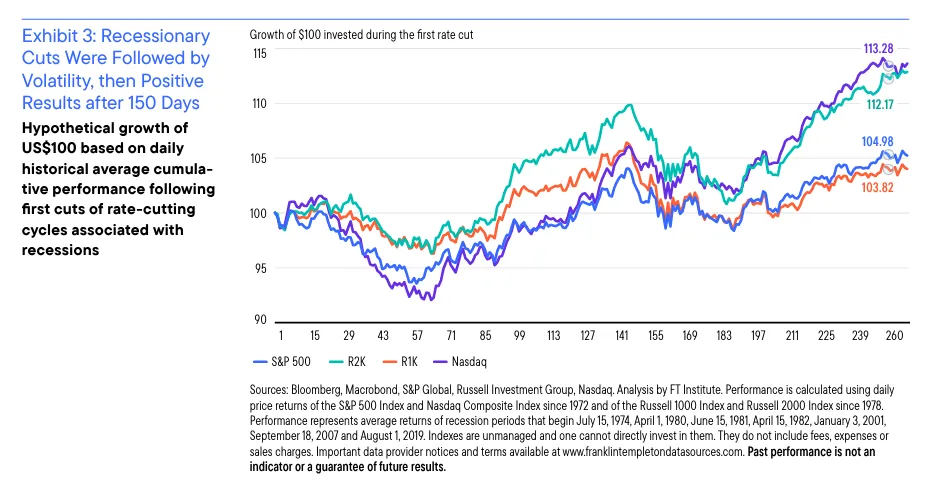
- Bearish Scenario (Recession): The Fed is forced to cut rates aggressively in response to a deteriorating economy and rising unemployment. In this scenario, cyclical sectors like small-caps and financials may initially fall due to earnings fears, outweighing the benefit of lower rates. Defensive sectors would outperform.
- “Higher for Longer” Persistence: The market has been prematurely pricing in rate cuts before. If inflation proves stickier than expected, forcing the Fed to delay cuts, the most rate-sensitive stocks could face a sharp sell-off as expectations are reset.
- Valuation Excesses: A rapid decline in rates could re-inflate speculative bubbles in the most sensitive areas (e.g., unprofitable tech), creating assets that are disconnected from fundamentals and vulnerable to a correction.
- Sector-Specific Risks: Always remember that interest rates are just one factor. A REIT can still fail due to poor property management. A small-cap can fail due to product obsolescence. Do not ignore company-specific fundamentals.
6. Strategic Implementation: How to Position Your Portfolio
Given these dynamics, a prudent investor should consider a phased and balanced approach:
- Avoid Timing the Exact Cut: It is nearly impossible to call the precise moment of the first cut. Instead, focus on the direction of policy. Begin scaling into positions as the data confirms a disinflationary trend and the Fed’s rhetoric turns dovish.
- Diversify Within the Theme: Instead of betting the farm on one small-cap stock, consider a basket approach via ETFs combined with a few high-conviction individual picks across REITs, regional banks, and tech.
- Maintain a Core Portfolio: Your portfolio’s core should still be built around high-quality companies with durable competitive advantages, regardless of interest rate sensitivity. The rate-cut-sensitive allocations should be a tactical overlay on a well-constructed strategic portfolio.
- Monitor Key Indicators: Keep a close watch on:
- CPI & PCE Inflation Reports: The primary drivers of Fed policy.
- The Fed’s “Dot Plot”: The summary of FOMC members’ own rate projections.
- The 2-Year Treasury Yield: This is highly sensitive to near-term Fed policy expectations.
- Economic Data (Jobs, GDP, PMI): To gauge whether cuts will be “soft landing” or “recession” driven.
7. Conclusion: Positioning for the Pivot
The impending shift in the Federal Reserve’s policy from restriction to easing is a pivotal moment that will redefine market leadership. While a rising tide may lift all boats to some extent, the sectors most tightly tethered to the cost of capital—Small-Caps, REITs, certain Financials, and long-duration Technology—are poised to experience the most significant tailwinds.
Successfully navigating this transition requires more than just a sector label; it demands a forensic analysis of balance sheets, an understanding of business cycle dynamics, and, most importantly, a clear-eyed view of why the Fed is cutting. By focusing on high-quality companies within these sensitive sectors that also possess strong secular growth prospects, investors can potentially enhance returns while managing the inherent risks. The period ahead is not about speculation, but about strategic positioning based on the fundamental mechanics of finance and a disciplined assessment of value.
Read more: Beyond Tech: Uncovering Value in Overlooked US Sectors like Industrials and Energy
Frequently Asked Questions (FAQ)
Q1: When are rate cuts expected to begin?
As of the latest data in Q3 2024, the market is anticipating the first rate cut potentially in September or December 2024, contingent on incoming inflation and employment data. However, this is a fluid forecast and can change with every new economic report.
Q2: Do all stocks go up when interest rates are cut?
No. While a rate-cutting cycle is generally supportive for the overall market, some sectors benefit more than others. Defensive, bond-proxy sectors like Consumer Staples and Utilities often underperform in the initial phase of a cutting cycle as investors rotate into more cyclical and rate-sensitive areas.
Q3: What are “long-duration assets” and why are they so sensitive?
A long-duration asset is one whose value is derived primarily from cash flows expected far in the future (e.g., 10+ years). Because the present value of distant cash flows is heavily reduced by a high discount rate, these assets are exceptionally sensitive to changes in interest rates. Most growth stocks fall into this category.
Q4: Why do regional banks benefit more from rate cuts than large money-center banks?
Large banks (e.g., JPMorgan Chase) have diverse revenue streams from investment banking and wealth management. Regional banks are more reliant on traditional lending. They are also more vulnerable to credit crunches and real estate downturns, so a stimulative rate cycle that improves borrower health and loan demand provides them with greater relative relief.
Q5: How can I invest in the “rate cut trade” without picking individual stocks?
Several ETFs provide targeted exposure:
- Small-Cap: iShares Russell 2000 ETF (IWM)
- REITs: Vanguard Real Estate ETF (VNQ)
- Regional Banks: SPDR S&P Regional Banking ETF (KRE)
- Long-Duration Growth: ARK Innovation ETF (ARKK)
Q6: What is the biggest mistake investors make when positioning for rate cuts?
The biggest mistake is becoming overexposed to the most speculative, high-risk names within a sensitive sector (e.g., the most heavily indebted small-cap or the most unprofitable tech stock) without considering why the Fed is cutting. If the cuts are due to a recession, these are the companies most likely to fail.
Q7: Are there any stocks that perform poorly when rates are cut?
Yes. As mentioned, defensive “bond proxy” stocks can see outflows. Furthermore, companies in the financial sector that rely heavily on net interest income (like some retail-focused banks) can see their profits squeezed if rate cuts compress their lending margins faster than their cost of funds falls.
Disclaimer: This article is for informational and educational purposes only and does not constitute financial advice, investment recommendation, or an offer to buy or sell any securities. The author and publisher are not registered as financial advisors. The views expressed are based on publicly available data and analysis and are subject to change. You should conduct your own research and consult with a qualified financial professional before making any investment decisions. Past performance is not a guarantee of future results. Investing involves risk, including the potential loss of principal.
Read more: The “Magnificent Seven” in 2024: Sustaining Growth or Facing Regulatory and Market Headwinds?