Introduction: The Wolf of Wall Street in Your Pocket
The promise is intoxicating: a tiny, unknown stock, trading for pennies, is on the verge of a meteoric rise. A cryptic tweet, a flashy YouTube video, or a late-night forum post hints that this is the “opportunity of a lifetime,” the chance to get in before the “big news” breaks and the stock explodes. The fear of missing out (FOMO) is a powerful force, and in the world of US penny stocks, it is the primary fuel for one of the oldest and most devastating financial scams: the pump-and-dump.
While the classic image of this scheme involves boiler rooms and cold calls, the modern pump-and-dump has evolved. It now plays out in real-time on social media platforms, encrypted messaging apps, and online forums, reaching millions with a speed and efficiency that earlier fraudsters could only dream of. The victims are no longer just the naive and elderly; they are often young, tech-savvy retail investors looking for their own “moon shot.”
This article is your shield. We will move beyond the hype and dissect the anatomy of a pump-and-dump scheme, arming you with three specific, actionable red flags to protect your capital. By understanding the mechanics of this manipulation and learning to identify its telltale signs, you can transform from a potential target into an informed, skeptical, and defensive investor. Our goal is not to teach you how to outsmart the manipulators, but how to avoid them entirely.
Section 1: The Anatomy of a Modern Pump-and-Dump
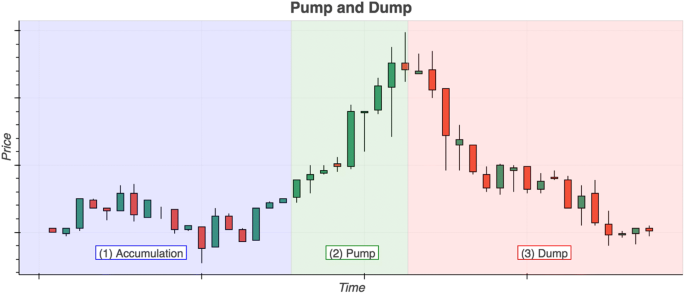
Before we can spot the red flags, we must first understand the machine. A pump-and-dump is a carefully orchestrated campaign of market manipulation designed to artificially inflate—”pump”—the price of a stock so that the perpetrators can sell—”dump”—their pre-purchased shares at a massive profit.
The Cast of Characters
- The Organizers (The “Insiders”): This is the inner circle, often comprising the company’s own executives, major shareholders (who may be hidden), or sophisticated offshore groups. They acquire a massive position in a low-priced, thinly-traded stock (often an OTC Pink sheet) at rock-bottom prices, long before the pump begins. Their identity is almost always concealed.
- The Promoters (The “Hype Men”): These are the public faces of the scheme. They can be:
- Paid Newsletters: Outfits that appear legitimate but are compensated in cash or free stock to publish glowing “research” reports.
- Social Media Influencers: Individuals on Twitter (X), YouTube, TikTok, or Discord with large followings who are paid to promote the stock without disclosing their compensation.
- Bot Networks: Thousands of automated social media accounts created to create a false sense of consensus and excitement.
- The Marks (The Retail Investors): This is the unfortunate group that buys into the hype during the pump phase. They are the necessary liquidity that allows the organizers to exit their positions. When the dump occurs, they are left holding worthless shares.
The Five-Act Play of a Pump-and-Dump
Act I: The Setup
The organizers quietly accumulate their position in a chosen stock. This stock is selected for its extreme illiquidity and low price; a small amount of buying pressure can cause a significant percentage move. The company itself may be a dormant shell with no real operations, making it a perfect vehicle for fraud.
Act II: The Narrative Creation
A compelling story is crafted. It’s always tailored to current, hot-button trends that are difficult for the average person to verify:
- “Our tiny biotech company has a revolutionary cure for [current disease].”
- “This mining company just discovered the largest lithium deposit in North America.”
- “We are pivoting to blockchain and our token will disrupt the entire industry.”
The narrative is never about boring fundamentals like revenue or profit; it’s about world-changing, futuristic potential.
Act III: The Coordinated Pump
This is the blitz. The promoters unleash a torrent of content across all channels simultaneously.
- Spam emails with subject lines like “URGENT BUY ALERT” or “The Stock Wall Street Doesn’t Want You to Know About.”
- YouTube videos with flashy thumbnails and titles promising “1000% GAINS!!!”
- Twitter/X and Discord floods of posts using specific $TICKER hashtags.
- Fake news articles posted on sham financial websites designed to look like Bloomberg or Reuters.
The message is unified: “Buy now, before it’s too late. The rocket is fueling.”
Act IV: The Frenzy and The Dump
As retail investors pile in, the price and volume spike dramatically. Charts go vertical. This frenzy creates a self-fulfilling prophecy for a brief moment, drawing in even more investors driven by FOMO. At the peak of this mania, the organizers begin silently selling their entire holdings into the inflated market. They sell and sell and sell, cashing out their pennies for dollars.
Act V: The Collapse
The selling pressure from the organizers overwhelms the buying from retail. The promoters go silent. The “news” never materializes. The price plummets, often falling below its pre-pump level. The retail investors are left with massive, irreversible losses, while the organizers vanish with their profits, ready to repeat the process with a new stock.
Now that we understand the playbook, let’s dive into the three critical red flags that can help you identify this scheme before you become a victim.
Read more: How Do Mergers and Acquisitions Create Market Shifts?
Red Flag #1: The Hype Machine – Aggressive, Unsolicited Promotion from Unverified Sources
The most obvious red flag is also the most effective. Manipulators must create artificial demand, and they do this by creating a deafening drumbeat of promotion.
How to Spot the Hype Machine:
1. The “Too Good to Be True” Language:
Be intensely skeptical of any communication that uses hyperbolic, pressure-filled language.
- Guarantees: “This is a guaranteed winner.” “Can’t lose opportunity.” In regulated investing, there are no guarantees.
- Urgency: “You must act before 4 PM EST today!” “The window is closing!” This is designed to short-circuit your critical thinking.
- Conspiracy Theories: “The big banks are trying to hide this stock!” This creates an “us vs. them” mentality and makes followers feel like they are part of an exclusive, smart in-group.
2. The Source is Not a Source at All:
- Unsolicited Contact: Did you find this “tip” in a direct message (DM) on social media? In the comments section of a financial blog? In a spam email from a sender you don’t recognize? Legitimate investment ideas do not arrive via these channels.
- Anonymous “Gurus”: Be wary of promoters who use screen names, hide their faces, or have no verifiable track record or professional credentials (like a CFA). Ask: What is their incentive? If they are so confident, why are they giving away the “secret” for free instead of quietly getting rich themselves?
- Paid Newsletters Disclaimers: This is a critical one. Always scroll to the very bottom of any promotional email or website. Legitimate paid newsletters are required by the SEC to include a disclaimer. Look for phrases like: “We are being compensated [amount] for the distribution of this material.” Or, “We own shares of [TICKER] that we purchased in the open market and will sell them during this campaign.” They openly admit they are being paid to pump the stock and plan to dump their shares. If you see this, run.
3. The Coordinated Social Media Blitz:
Go to Twitter/X or a stock forum like StockTwits and search for the $TICKER symbol. A red flag is a high volume of nearly identical, low-substance posts from newly created accounts or accounts that do nothing but promote penny stocks.
- Example Posts: “OMG $ABCD is about to explode!,” “Loading the boat on $ABCD before the news!,” “To the moon! 🚀 #ABCD.”
- Lack of Analysis: You will see almost no posts discussing the company’s balance sheet, income statement, management team, or competitors. The discussion is 100% emotion and momentum.
Defensive Action: If you encounter aggressive, unsolicited promotion, your default action should be to ignore and avoid. Do not engage. Do not try to “ride the wave.” Treat it as what it is: marketing material for your own financial destruction.
Red Flag #2: The Ghost Company – A Dearth of Verifiable, Substantive Information
Pump-and-dumps almost exclusively target companies that are financial ghosts—entities with little to no real business operations, assets, or verifiable information. The manipulators rely on this opacity; a compelling fiction is impossible to maintain if the truth is easily accessible.
How to Investigate the Company’s Substance:
1. Check the Company’s Domicile and Tier on the OTC Markets:
The first and easiest step is to go to the OTC Markets website (otcmarkets.com) and type in the stock ticker. The landing page for the stock provides a wealth of instant credibility (or lack thereof).
- The OTC Tiers:
- OTC Pink (The Danger Zone): This is the lowest tier with the highest risk. It is further categorized by the level of information provided. This is the home of 99% of pump-and-dumps. If your stock is here, especially labeled “No Information,” treat it as guilty until proven innocent.
- OTCQB (The Venture Stage): Companies here must be current in their reporting and undergo an annual verification. While still speculative, it’s a significant step up in transparency. Pump-and-dumps are less common here.
- OTCQX (The Premier Tier): Companies must meet high financial standards and be fully reporting. It is highly unlikely to find a pump-and-dump on this tier.
- The Company Profile: Look at the company’s business description. Is it vague? Does it use a lot of buzzwords (“disruptive,” “groundbreaking,” “paradigm-shifting”) without explaining what it actually does? Does it list a real address, or just a P.O. Box or “virtual office”?
2. Scour the SEC’s EDGAR Database:
For companies on OTCQB and OTCQX (and some on Pink “Current Information”), you can access their official filings for free on the SEC’s EDGAR database.
- What to Look For:
- The 10-K (Annual Report): This is the most comprehensive filing. Does it even exist? Open it. Look at the balance sheet. Does the company have any real assets or revenue? Or does it have massive debt and years of consecutive losses? A company with $10,000 in revenue and $5 million in debt is a shell, not a business.
- The 10-Q (Quarterly Report): Check for any updates or changes.
- The 8-K (Current Report): This reports significant events. Are there reports of a change in auditors? A sudden resignation of the CEO or CFO? These are massive red flags.
- What the Absence Reveals: If the company is on the Pink “No Information” tier and has no filings in EDGAR, you are being asked to invest in a complete black box. You have no way of knowing who runs it, what it owns, or how it makes money. This is the manipulator’s ideal playground.
3. Interrogate the “Catalyst”:
The pump narrative always revolves around an imminent, company-changing catalyst.
- The “Groundbreaking” Patent: Is there a verifiable patent number? Can you look it up on the USPTO website? Often, the “patent” is just a pending application with no guarantee of approval.
- The “Massive” Contract: Is the partner company a real, reputable entity? Is there a press release from the partner’s side? If not, it likely doesn’t exist.
- The “Imminent” FDA Approval: For biotech penny stocks, this is a classic. Check the actual FDA database. The timeline for drug approval is measured in years, not days. A company claiming imminent approval for a drug that has only completed Phase I trials is lying.
Defensive Action: If you cannot independently verify the company’s business, financials, and the central claim of the hype through the OTC Markets website and SEC EDGAR, the investment does not exist. You are betting on a story, not a company.
Read more: Which U.S. Energy Companies Are Emerging as Market Leaders?
Red Flag #3: The Mirage of Volume – Abnormal Trading Activity That Signals Manipulation
The market’s most basic signals—price and volume—can be twisted into tools of deception. Manipulators understand that a soaring chart attracts attention like a moth to a flame. They artificially create this activity to lure in momentum traders.
How to Analyze Trading Activity for Red Flags:
1. The Volume Spike Precedes the News:
In a legitimate company, positive news is released, and then the market reacts with higher volume. In a pump-and-dump, the sequence is often reversed.
- The Pattern: You will see a massive, unexplained spike in trading volume one or two days before a major press release. This is a near-certain sign of information leakage and insider buying by the organizers setting up the pump. They are getting in before they unleash the promotional campaign.
2. The “Vertical” Price Move on High Volume:
While high volume and rising prices can indicate genuine discovery, the context is key. A stock that goes up 200% in a single day on volume that is 100x its average is almost certainly being manipulated. This is not organic growth; it is the coordinated buying of the promoter network and the resulting FOMO from retail. Such vertical moves are unsustainable and are designed for one thing: the dump.
3. The Bid-Ask Spread Tell:
Remember, these are illiquid stocks. Look at the Level 2 quote data (the “order book”) in your brokerage platform.
- A Wide Bid-Ask Spread: In a healthy, liquid stock, the difference between the bid and ask is pennies. In a manipulated penny stock, the spread can be enormous—10%, 20%, or even 50% of the share price. A stock quoted at $0.50 Bid / $0.65 Ask means it instantly has to rise 30% just for you to break even. This illiquidity is a hallmark of the OTC Pink world and a major tool for manipulators.
4. The Churn and Burn of Tickers:
Pump-and-dump groups often reuse the same shell companies. You might see a stock pump and collapse, only to go dormant for a year. Then, it suddenly announces a “reverse merger” into a “revolutionary new crypto company,” changes its name and ticker symbol, and the entire cycle begins again. This is the financial market’s version of a snake shedding its skin.
Defensive Action: Use a charting platform to look at the historical price and volume of the stock. If you see a vertical price line on record volume that appears out of nowhere, assume it is artificial. Do not chase it. Understand that in an illiquid market, your entry price is often terrible and your exit may be impossible.
Conclusion: Empowerment Through Skepticism
The world of US penny stocks is a high-risk ecosystem where the line between speculation and fraud is often deliberately blurred. The pump-and-dump scheme is a predatory but avoidable threat. By internalizing the three red flags—The Hype Machine, The Ghost Company, and The Mirage of Volume—you equip yourself with a powerful defensive toolkit.
Protecting your capital is not about finding the next big winner; it’s about diligently avoiding the countless certain losers. The most profitable trade you will ever make is the one you avoided. Let skepticism be your default setting, due diligence your mandatory ritual, and a long-term, disciplined investment strategy your guiding principle. In the end, the greatest power an investor has is not the ability to say “yes” to every opportunity, but the wisdom to say “no” to the bad ones.
Frequently Asked Questions (FAQ)
Q1: I bought into a pump-and-dump and am now at a loss. What should I do?
- The first step is to emotionally accept the loss and avoid the “sunk cost fallacy”—the idea that you should hold on until it “comes back.” These stocks rarely do. Consult with a financial advisor or a tax professional. You may be able to sell the position and use the capital loss to offset gains in other investments for tax purposes. Most importantly, view it as a costly but valuable lesson in due diligence.
Q2: Are these schemes illegal, and does the SEC go after them?
- Yes, pump-and-dumps are illegal under federal securities laws for market manipulation and fraud. The SEC does actively investigate and prosecute these schemes. However, the organizers are often sophisticated, using offshore accounts and encrypted communications, making them difficult to catch and prosecute. Enforcement actions can take years, and by then, victim recovery is often minimal. Prevention is infinitely better than hoping for restitution.
Read more: Which U.S. Energy Companies Are Emerging as Market Leaders?
Q3: What about “reverse pump-and-dumps” or “short and distort”?
- This is a related manipulation where traders who have shorted a stock (bet against it) then spread false negative information to drive the price down so they can profit. It’s the mirror image of a pump-and-dump and relies on the same principles: spreading misinformation and exploiting fear instead of greed. The defensive playbook is the same: rely on verified information, not hype or FUD (Fear, Uncertainty, and Doubt).
Q4: I saw a promotion from someone with a huge following. Could it still be a pump?
- Absolutely. A large follower count does not equal credibility or integrity. Influencers can be paid enormous sums to promote a stock to their audience, and their disclosure of this payment is often buried or non-existent. Always do your own independent research regardless of the source. Never outsource your investment decisions to a social media personality.
Q5: Where can I report a suspected pump-and-dump scheme?
- You can and should report it to the SEC through their online Tips, Complaints, and Referrals (TCR) system. Providing details like the ticker symbol, the promoters involved, and links to promotional material can aid their enforcement efforts.
Q6: Is there any scenario where a low-priced, high-volume stock is a legitimate investment?
- It is possible, but it is the exception that proves the rule. A legitimate micro-cap company on the OTCQB tier might have a volume spike after releasing genuinely positive, verifiable news like a major, contracted customer win or breakthrough clinical trial results that are documented in an SEC filing. The key differentiator is the presence of substance behind the move, which can be found through the rigorous due diligence steps outlined in Red Flag #2.
Disclaimer: This article is for educational and informational purposes only and should not be construed as specific investment, financial, legal, or tax advice. The information presented is based on sources believed to be reliable but is not guaranteed. All investing, particularly in penny stocks, involves risk, including the potential loss of principal. Always conduct your own thorough due diligence and consult with a qualified financial professional before making any investment decisions. The author and publisher are not responsible for any financial losses resulting from actions taken based on the information in this article.
Read more: What Role Do Hedge Funds Play in Moving the U.S. Market?